


When you get down to it, the analog vs. digital watch debate is really a question of personal priorities. What do you value more? In short, analog watches are for those who appreciate timeless craftsmanship and style, while digital watches serve those who need feature-rich functionality. This isn't about which one is better, but which one is better for you.
Choosing Between Timeless Artistry and Modern Tech
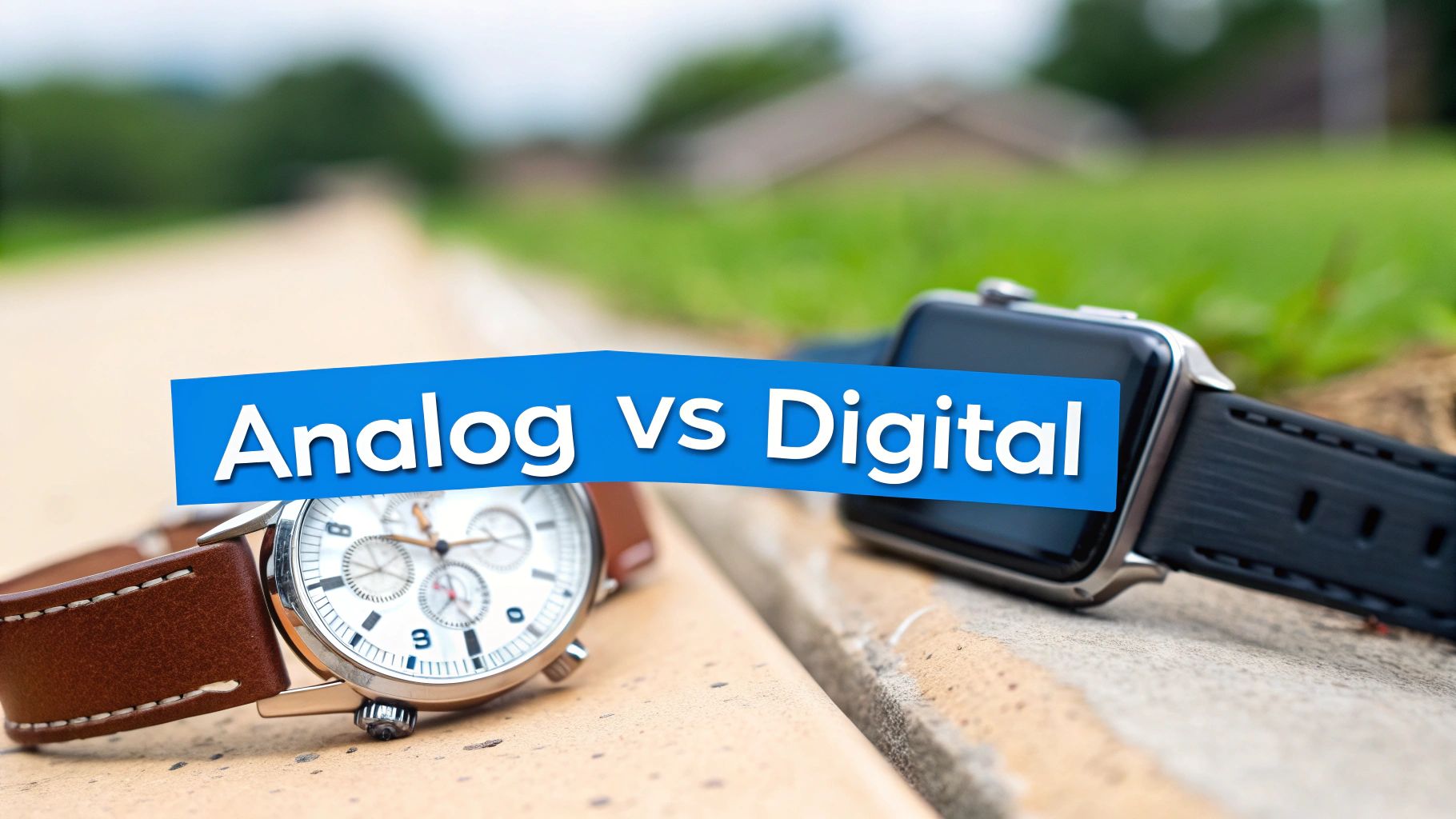
The choice between an analog and a digital watch really pits the mechanical soul of traditional watchmaking against the practical power of modern microprocessors. Your decision ultimately shapes how you interact with time—whether you see it as an appreciation of artistry or as a tool for managing data.
Before we dive deep into the nuances, let's get a high-level view. The table below breaks down the core differences to help frame your thinking.
Analog Vs Digital At A Glance
| Attribute | Analog Watch | Digital Watch |
|---|---|---|
| Display | Hands on a dial (hour, minute, second) | Numeric display (LCD or LED screen) |
| Primary Focus | Craftsmanship, aesthetics, and tradition | Functionality, data, and connectivity |
| Movement | Mechanical (automatic/manual) or Quartz | Exclusively Quartz or processor-driven |
| Best For | Formal events, professional settings, style | Sports, fitness tracking, casual wear |
| Key Appeal | Timeless elegance and heirloom potential | Practical features and modern convenience |
| Maintenance | Periodic servicing (mechanical); battery changes | Battery changes or regular charging |
This table gets right to the heart of the conflict: style versus utility. An analog timepiece, especially a mechanical one, is celebrated for its intricate engineering and enduring design. It's often viewed as a piece of jewelry, which is why so many collectors learn the nuances of a classic dress watch before making their first big purchase.
This idea of balancing timeless elegance with modern appeal in accessories is key in today's fashion landscape. In contrast, digital watches, including their smartwatch cousins, are all about performance. They’re tools built to deliver precise information, track your metrics, and keep you connected.
Despite the explosion of smart technology, the allure of classic design isn't just holding on—it's thriving. In the U.S. watches market, analog models command a staggering 93.46% revenue share. That's not a typo.
This trend is even stronger in the luxury sector, where analog watches dominate the global market. It’s clear that when a watch is seen as a statement piece or a long-term investment, tradition and artistry almost always win out.
The Heart of the Watch Movement and Mechanism
To really get to the bottom of the analog vs. digital debate, you have to look past the dial and into the very core of the timepiece—its movement. This is the engine that powers the watch, and it’s where traditional watchmaking and modern electronics fundamentally part ways. Think of it this way: an analog watch has a mechanical or quartz "heartbeat," while a digital watch runs on a silicon "brain."
For a lot of collectors, the soul of a fine analog watch is its mechanical movement. We're talking about a tiny, self-contained world filled with hundreds of minuscule gears, springs, and levers, all working together in perfect sync. There are no batteries, no circuits—just pure, kinetic artistry.
A mechanical movement runs on energy stored in a tightly wound mainspring. As it unwinds, it releases that energy in a controlled trickle through a complex gear train, which is what moves the watch's hands.
The Two Souls of Mechanical Watches
Within the mechanical family, you'll find two main types, and each offers a totally different experience:
- Manual-Wind Movements: These are the old-school purist's choice. They require the wearer to turn the crown every day to wind the mainspring. It's a simple act, but one that creates a real connection to the watch—a daily ritual many enthusiasts wouldn't trade for anything.
- Automatic (Self-Winding) Movements: A more convenient take on the classic, automatic movements have a weighted rotor that spins with the natural motion of your wrist. This constant movement keeps the mainspring wound, so you don't have to think about it as long as you're wearing the watch regularly.
The mind-boggling craftsmanship of a mechanical movement is a true celebration of human ingenuity. It’s a tiny machine that, with proper care, can run for generations. It’s a legacy that modern tech just can’t replicate.
The Quartz Revolution in Analog Design
While mechanical movements are all about tradition, the quartz movement brought a new level of precision and accessibility to analog watches. A quartz movement uses a battery to send a tiny electrical current through a quartz crystal, making it vibrate at an unbelievably precise frequency: 32,768 times per second. A circuit then counts these vibrations and translates them into a single electrical pulse every second, which drives a small motor to move the watch hands.
The key takeaway here is that quartz movements are far more accurate and need much less maintenance than their mechanical cousins, making them a super practical and reliable choice for a daily watch. This is a huge reason they dominate the market.
This reliability explains why quartz-powered analog watches are everywhere. In fact, quartz analog watches shipped a staggering 112 million units globally, making up 75% of total wristwatch shipments when combined with mechanicals. They're the workhorses of the watch world, giving you that classic look with set-it-and-forget-it ease. For a deeper dive, check out our guide on automatic vs. quartz movements.
The Digital Watch's Electronic Core
The inside of a digital watch couldn't be more different. Instead of gears and springs, you have a microprocessor at its core. This is the same basic technology you'd find in a computer or smartphone, just shrunk down to fit on your wrist.
A digital watch also uses a quartz crystal to keep time, but that's just the start. The microprocessor is the central command, managing not just the time display but a whole suite of other features.
Here's a quick rundown of how it works:
- Power Source: A battery supplies the electricity.
- Timekeeping: A quartz oscillator gives the precise timing signal.
- Processing: The microprocessor takes that signal and processes it, along with input from other sensors (like an accelerometer or heart rate monitor).
- Display: The processor then tells the liquid crystal display (LCD) or light-emitting diode (LED) screen what to show, displaying the time and other data in a digital format.
This design is all about utility and function, not artistry. The value isn't in the intricate dance of moving parts, but in the power and versatility of its electronics. The soul of a digital watch is what it can do—it's a piece of modern tech designed to manage information and connect to your life.
Durability, Accuracy, And Longevity: A Side-By-Side Comparison
When you look past the dial and consider the practical realities of owning a watch, the differences between analog and digital really come into focus. It’s not just about aesthetics; it’s about how a watch performs day-to-day, how it holds up, and what it demands from you over a lifetime.
These three factors—accuracy, durability, and longevity—highlight the core trade-offs between mechanical artistry, quartz efficiency, and digital power. Each path offers a completely different ownership experience.
The watch's movement is the engine that dictates these attributes. Here’s a quick overview.
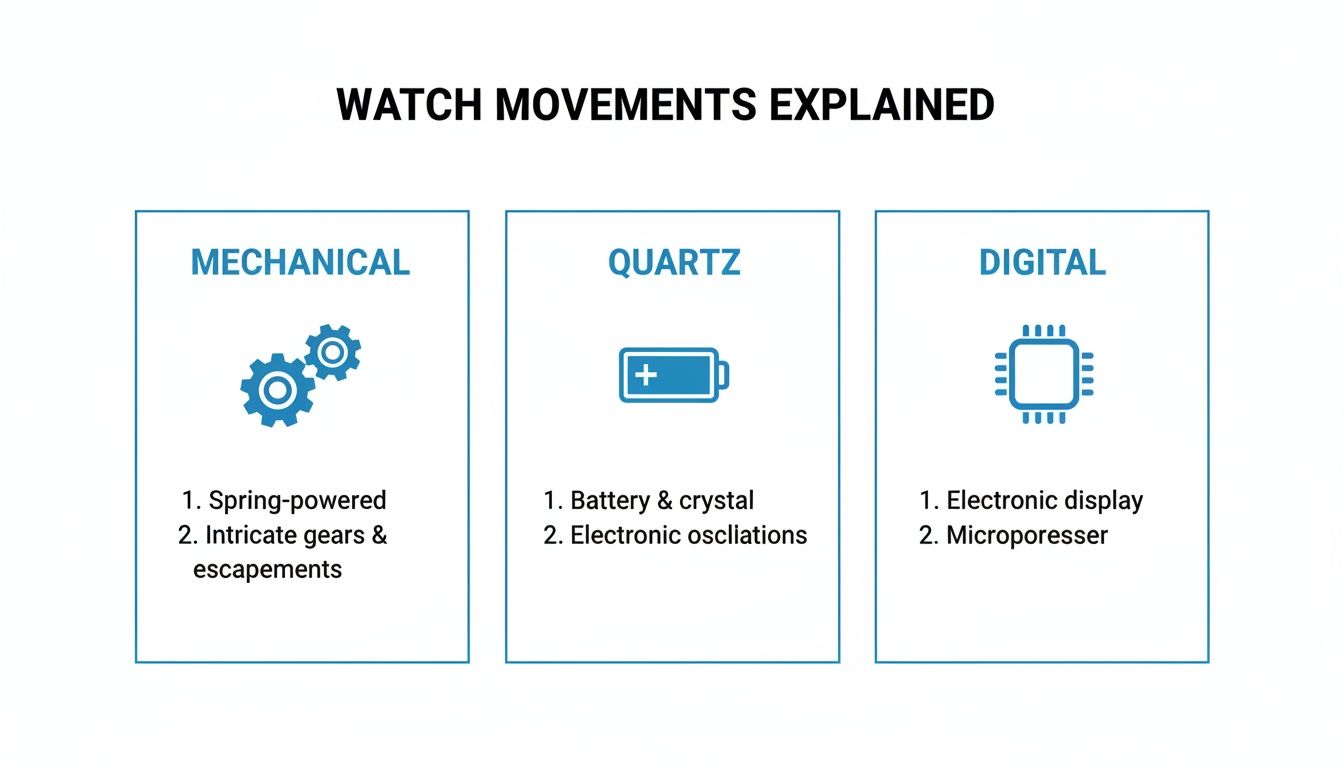
As the infographic shows, it's a choice between intricate engineering (mechanical), battery-powered precision (quartz), or advanced electronic functionality (digital).
The Nuances Of Timekeeping Accuracy
In a basic sense, any modern watch you buy will keep good time. But the degree of accuracy—and the work needed to maintain it—varies dramatically.
A mechanical watch is a beautiful piece of micro-engineering, but it's also the least precise of the bunch. A top-tier luxury mechanical timepiece is considered exceptional if its accuracy is within +/- 2 to 5 seconds per day. This slight drift is part of its charm, a result of hundreds of tiny gears working in harmony, influenced by gravity, temperature, and your own movements.
Quartz analog watches were a game-changer for precision. They use a battery to send an electrical current through a tiny quartz crystal, causing it to vibrate at a precise frequency. The result? Accuracy typically within +/- 15 to 20 seconds per month. They are incredibly reliable and require almost no thought.
Digital watches, particularly smartwatches, are in a league of their own. Most sync automatically with atomic clocks via the internet or radio signals, making them accurate to a fraction of a second. They correct themselves constantly, offering absolute precision.
This boils down to a clear choice for any owner. Do you appreciate the living, breathing imperfection of a mechanical movement? Do you prefer the set-it-and-forget-it reliability of quartz? Or do you need the absolute, self-correcting precision of a digital device?
A Tale Of Two Durabilities
Durability isn't just about surviving a drop. It's about resisting the scratches, scuffs, and impacts of daily life. Analog and digital watches are built with very different philosophies in mind.
Luxury analog watches are often built for scratch resistance. They almost universally use sapphire crystal for the watch face—a material so hard it can only be scratched by a diamond. This ensures the dial stays flawless for decades, though a hard, direct impact can cause it to shatter.
Digital and smartwatches, on the other hand, are designed for active use and prioritize impact resistance. They often use mineral glass or specialized materials like Gorilla Glass. While these can scratch more easily than sapphire, they are far better at absorbing shocks from bumps and drops, making them perfect for sports or outdoor adventures.
The case materials tell a similar story:
- Analog: Usually crafted from premium materials like stainless steel, titanium, or precious metals (gold, platinum), with a focus on beauty and longevity.
- Digital: Typically made from lightweight, functional materials like resin, carbon fiber, and aluminum to maximize comfort and toughness during physical activity.
A Practical Comparison Of Watch Attributes
Here's a straightforward breakdown of how these different watch types stack up on the most important day-to-day attributes.
| Feature | Mechanical Analog | Quartz Analog | Digital/Smartwatch |
|---|---|---|---|
| Accuracy | +/- 2 to 5 seconds per day | +/- 15 to 20 seconds per month | Near-perfect (atomic/internet sync) |
| Maintenance | Requires servicing every 5-7 years | Battery change every few years | Daily/weekly charging, software updates |
| Typical Lifespan | Potentially 100+ years (heirloom) | 20-30+ years | 3-5 years (becomes obsolete) |
| Durability Focus | Scratch resistance (sapphire crystal) | Balanced | Impact resistance (mineral/Gorilla Glass) |
This table makes the trade-offs clear: mechanical watches offer generational longevity at the cost of regular maintenance. Quartz provides decades of hassle-free reliability, while digital offers peak modern functionality within a much shorter, tech-driven lifespan.
The Long-Term Commitment: Maintenance And Longevity
The final consideration is how a watch ages and what it requires from you. This is where you see the biggest split between watches designed for permanence and those built for the present.
A well-made mechanical analog watch is built to outlive you. It's a potential heirloom. But like a classic car, it needs regular care. Expect to have it professionally serviced every 5 to 7 years to be cleaned, lubricated, and have worn parts replaced. This ritual is a key part of the ownership experience.
A quartz analog watch is the low-maintenance option. All it really needs is a new battery every couple of years. While the electronic movement isn't designed to be serviced like a mechanical one, a quality quartz watch can easily run for 20-30 years or more.
Digital and smartwatches have a lifecycle more like a smartphone than a traditional timepiece. "Maintenance" means charging it daily or weekly and keeping the software updated. Longevity isn't measured in decades but in years, tied directly to battery health and technological obsolescence. You can expect a 3 to 5-year lifespan before the battery degrades or it’s simply outmatched by newer models.
This is the ultimate distinction. Analog watches offer the promise of permanence, while digital watches deliver powerful but temporary utility. One is an investment in heritage; the other is an investment in current technology.
Defining Functionality Beyond Telling Time
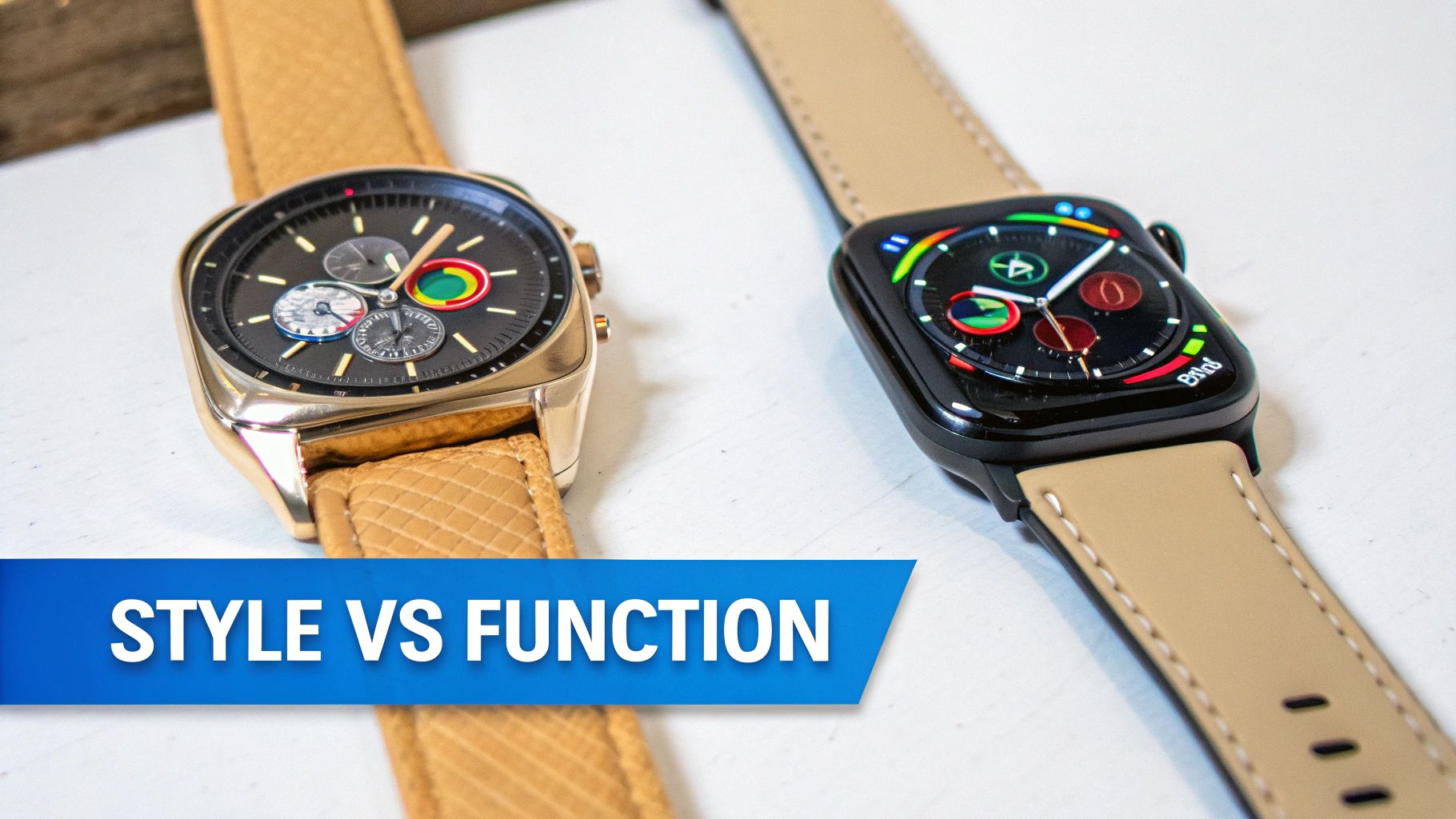
Once you get past the simple act of telling time, what do you really need your watch to do? This is the core question that separates analog and digital timepieces, forcing you to choose between mechanical artistry and digital utility. Your answer says a lot about the role a watch plays in your life.
For the analog purist, the beauty is in the focus. Extra capabilities aren't just "features" in the tech sense; they're complications—tiny, intricate masterpieces of engineering that enhance the timekeeping experience. An analog watch tells a story of craftsmanship on your wrist.
A digital watch, on the other hand, is a command center. It’s built to manage your day, pulling a massive amount of data, communication, and health tracking into one device.
The Mechanical Artistry of Analog Complications
In the world of luxury analog watches, a "complication" is any function beyond the basic hours, minutes, and seconds. These aren't just add-ons; they are complex mechanisms woven directly into the watch's movement, each one a testament to the watchmaker’s skill. They represent the absolute pinnacle of traditional horology.
Some of the most celebrated analog complications include:
- The Chronograph: At its heart, a sophisticated stopwatch. It lets you measure elapsed time without stopping the main timekeeping function and is a classic on iconic models like the Rolex Daytona.
- The Moon Phase: A poetic complication that displays the lunar cycle on the dial. It's a beautiful nod to the historical roots of timekeeping, when celestial events were our primary clocks.
- The GMT or Dual Time: An essential for travelers, this complication tracks a second time zone, usually with an additional 24-hour hand. It’s a highly practical function executed with mechanical elegance.
These complications are revered not just for what they do, but how they do it. They are physical expressions of ingenuity, adding real depth and character to a timepiece without ever needing a screen or a battery. An analog watch with complications is a specialized instrument, not a jack-of-all-trades gadget.
The Digital Ecosystem of Smart Functionality
Digital watches, especially modern smartwatches, have completely blown up the idea of what a timepiece can do. Their potential isn't limited by gears and springs but by software and sensors, creating an almost limitless platform for new functions. Their value is measured in data points and connectivity.
The market reflects this massive shift. The global digital watch industry is projected to hit USD 115.7 billion by 2034, a huge leap from its current value. This explosive growth is driven by smart features that are now deeply integrated into our daily lives, with the number of smartwatch users expected to reach 454.69 million worldwide. You can find more insights on this market expansion on market.us.
A modern digital watch is a life-management tool. Its core functions usually include:
- Advanced Health Monitoring: Tracking everything from heart rate and blood oxygen (SpO2) to sleep patterns and ECG readings.
- Seamless Communication: Handling notifications, calls, and texts right from your wrist.
- GPS and Navigation: Giving you real-time directions and location data for workouts or travel.
- Contactless Payments: Letting you make secure payments with a simple tap.
The critical difference here is intent. An analog complication adds a specific, masterfully engineered function to the art of telling time. Digital features, in contrast, aim to replace other devices, consolidating your entire digital life onto your wrist.
Ultimately, the choice boils down to what you need day-to-day. Are you looking for a beautifully crafted instrument that performs a few key tasks with mechanical perfection? Or do you need a powerful, connected hub that can manage almost every part of your modern life? Your answer will tell you whether to wear a piece of heritage or a piece of technology.
Understanding Investment and Resale Value
When you get down to the brass tacks of analog vs. digital, the financial side of things is where they really part ways. A watch can be a tool you buy for a specific job, or it can be a long-term asset. This single choice dramatically changes its potential to hold—or even gain—value over time.
Mechanical analog watches, particularly those from the big luxury houses, are often seen as appreciating assets. Their value comes from a blend of qualities that a digital device simply can't touch. You're buying into brand history, scarcity, and a level of hands-on craftsmanship that keeps demand high, often higher than the available supply.
The Analog Watch as an Asset
The staying power of a high-end analog watch is built on a few solid pillars:
- Brand Heritage and Prestige: A name like Rolex or Patek Philippe isn't just a brand; it’s a legacy built over centuries of innovation. That history translates directly into unwavering demand and strong resale prices.
- Meticulous Craftsmanship: The hundreds of hours a master watchmaker pours into assembling a complex mechanical movement is pure artistry. Collectors and enthusiasts value that tangible skill and human effort.
- Rarity and Exclusivity: Limited production models, discontinued references, or unique material combinations create a scarcity that can push market prices far beyond the original sticker price.
These factors transform a mechanical watch from a simple time-teller into a potential family heirloom. It becomes a hard asset that can be passed down to the next generation or sold for a healthy return. If you're serious about this side of collecting, our guide on investing in luxury watches dives much deeper into market dynamics.
A luxury mechanical watch is an investment in tangible art and enduring brand equity. Its value isn't tied to its tech specs but to its status as functional, wearable art.
The Digital Watch Depreciation Model
Digital and smartwatches, on the other hand, follow the same financial path as any other piece of consumer electronics. Their value is welded to their technology, which has an incredibly short shelf life. The cutting-edge smartwatch of today is just like a smartphone or laptop—it's destined to be outdated in just a couple of years.
This rapid innovation cycle means digital watches are built to be replaced, not treasured. Their worth is all about what they can do for you right now. As soon as new models appear with better sensors, faster chips, and longer battery life, the previous versions plummet in value on the secondary market.
This makes a digital watch a useful, but ultimately disposable, purchase. It's a tool for today, not an asset for tomorrow. So, the decision isn't just about features or style; it’s about your financial outlook. Are you buying a potential heirloom that could grow in value, or are you buying a powerful piece of modern tech built for the moment? Getting that distinction right is crucial.
Making Your Final Decision: The Right Watch For You
Choosing between an analog and a digital watch goes way beyond a simple feature list. It’s a reflection of who you are, what you value, and how you move through the world. The right timepiece should feel like an extension of yourself.
To help you decide, let's look at which watches best suit different lifestyles. This isn't about one type being "better"—it's about finding the right tool for your life's demands.
The Boardroom Leader
For the executive who walks into a room and commands respect, a watch is a powerful, non-verbal cue. In this arena, nothing beats a classic mechanical analog watch. A timepiece from a legendary maker like Rolex or Patek Philippe signals a deep appreciation for heritage, precision craftsmanship, and lasting value—qualities that mirror strong leadership.
Its job isn't just to tell time. It's to convey a message of permanence and discipline. The quiet elegance of a dress watch or a refined chronograph is the perfect final touch to business attire, adding an unmistakable layer of authority.
The Modern Athlete
Today's athlete is driven by data. Every metric matters, from splits and heart rate to sleep and recovery. The ultimate training partner? A digital smartwatch. It puts vital stats right on your wrist—GPS tracking, heart rate monitoring, and advanced performance analytics—all wrapped in a tough, lightweight package.
But its utility doesn't stop at the gym door. With notifications and all-day health monitoring, it supports a high-performance lifestyle around the clock. This watch isn't just a timekeeper; it's a tool for progress.
The Aspiring Collector
For someone just starting their journey into the world of horology, the focus is on mechanics, heritage, and future value. A high-quality automatic analog watch from a respected brand like Omega or Tudor is the perfect entry point.
This choice is a gateway into the intricate world of mechanical movements and timeless design, without the intimidating price tag of top-tier luxury. It’s a piece to be worn, studied, and enjoyed—the first chapter in a lifelong passion for watchmaking.
The Everyday Professional
The everyday professional needs one watch that can do it all: versatile, dependable, and sharp enough for any scenario. This is where a quartz analog watch shines. It delivers that classic, office-appropriate aesthetic with the set-it-and-forget-it convenience a busy life demands.
This watch is the ultimate dependable workhorse. It’s always accurate, needs very little maintenance, and transitions seamlessly from a client meeting to a casual weekend. You get timeless style without the upkeep of a mechanical piece, making it the perfect practical choice.
Your Questions, Answered
Choosing between analog and digital isn't just about looks; it's about how a watch fits into your life. Here are a few common questions we hear from clients trying to make that final decision.
Can I Wear a Digital Watch to a Formal Event?
While old-school style guides would give you a hard "no," things have loosened up a bit. A very sleek, minimalist digital watch—think a dark screen and a high-quality strap—can definitely pass in business-casual or modern settings.
However, for a true black-tie affair, a classic analog dress watch is still the undisputed king.
The real principle here is about distraction. A beautiful analog watch complements your outfit. A digital watch buzzing with notifications can easily detract from the occasion's formality. It really comes down to the impression you want to make.
Which Watch Is More Durable for Everyday Wear?
This depends on what your "everyday" looks like. For pure, rugged toughness during high-impact activities, a digital watch usually wins. Brands like G-Shock are purpose-built with shock-absorbing resin and mineral glass to take a serious beating.
On the other hand, luxury analog watches are engineered for a different kind of durability. They often feature near-indestructible sapphire crystal to resist scratches from daily professional life. They're tough, but not designed for the same abuse as a dedicated sport watch.
Is an Analog Watch Still a Good Investment?
Absolutely—if you choose wisely. A high-quality mechanical watch from a legendary brand like Rolex, Patek Philippe, or Audemars Piguet is widely seen as an appreciating asset. Its value is rooted in heritage, craftsmanship, and rarity, all of which are immune to technological updates.
A digital watch is better viewed as a technology purchase. It delivers incredible function for a few years but will inevitably depreciate as newer, better models are released. One is a potential heirloom; the other is a temporary tool. In the analog vs digital watch debate, this is a crucial financial distinction.
Whether you're seeking an investment-grade timepiece or a sophisticated daily companion, ECI Jewelers offers a curated collection of the world's finest authenticated luxury watches. Explore our inventory online or visit our NYC showroom to find the perfect watch that tells your story.


