


When people talk about diamond clarity, they're really talking about purity. Think of a diamond like a window—the fewer smudges or imperfections it has, the clearer the view and the more light can stream through. It’s that unobstructed journey of light that creates the sparkle we all love.
Put simply, a higher clarity grade means the diamond is purer, rarer, and more valuable.
What Is Diamond Clarity and Why It Matters
Clarity is one of the famous "4Cs" that define a diamond's quality, right alongside cut, color, and carat weight. It specifically grades the visual purity of a diamond by looking for tiny internal and external flaws.
These characteristics are completely natural, formed deep inside the earth as the diamond grew under mind-boggling heat and pressure. We call the internal marks inclusions and the external ones blemishes. In a way, they're like a diamond's unique fingerprint, telling the story of its formation millions of years ago.
The Impact of Imperfections
The final clarity grade depends on the size, number, placement, and type of these natural marks. Most are so small you'd need a jeweler's loupe to see them, but larger or more numerous flaws can sometimes affect a diamond’s sparkle and even its durability.
A diamond with high clarity lets light pass through it with almost nothing in the way. This is what creates that breathtaking brilliance and fire that makes a diamond so mesmerizing.
Fewer imperfections don't just make a diamond more beautiful; they also make it much rarer. This direct link between a diamond's purity and its rarity is what drives a huge part of its price. Getting a handle on this relationship is the first step to buying a diamond with confidence.
How Clarity Should Influence Your Choice
Choosing the right clarity is all about striking a smart balance between visual perfection and your budget. For most people, the goal isn't a technically flawless diamond—which comes with a huge price tag—but one that is "eye-clean." This just means none of its inclusions are visible without magnification.
Finding that sweet spot is a key strategy we talk about in our guide to buying engagement rings, where we help you get the most impressive diamond for your money.
Ultimately, clarity has a direct impact on three things:
- Beauty: Fewer flaws mean better light reflection, which equals more sparkle.
- Rarity: Truly flawless diamonds are incredibly rare, making them collector's items.
- Value: Because they're so rare and beautiful, higher clarity grades always cost more.
Next, we'll dive into the GIA's clarity scale, from the pinnacle of Flawless (FL) down to the Included (I) grades. This knowledge will give you the power to read a grading report like a pro and choose a diamond that's the perfect blend of beauty and value.
The Universal Language of Diamond Grading
Can you imagine trying to buy a diamond a century ago? It was a wild west. The market was a mess of confusing, subjective terms like "river" or "cape" to describe a stone's quality. One seller's idea of a "top quality" diamond might be completely different from another's, making it impossible to compare stones fairly. You could never be sure you were getting what you paid for.
This lack of a common language created huge problems in the global diamond trade. Without objective standards, there was no real transparency or way to protect consumers. The industry was desperate for a scientific, reliable system that everyone—from miners and cutters to jewelers and customers—could trust.
The Birth of the Modern Standard
Everything changed in the early 1950s when the Gemological Institute of America (GIA) stepped in to bring order to the chaos. They set out to create a grading system rooted in science, not opinion, so a diamond bought in New York could be accurately compared to one in Antwerp. This system would become the very foundation of modern gemology.
The real work kicked off in 1952, led by Richard T. Liddicoat and his GIA colleagues. By 1953, they had officially introduced a system that assessed diamonds based on their cut, color, and clarity. This established the nine original clarity grades, from Flawless all the way down to Included. This was the single most important development in the history of the diamond industry, creating a universal language for quality that we still use today. You can learn more about diamond clarity history and how it has evolved.
Why a GIA Report Matters Today
This standardized grading system did more than just clean up the market; it empowered you, the buyer. Before the GIA, you had to take a jeweler's word for it. Afterward, you had an impartial, third-party report that spelled out exactly what you were buying.
This history is why a GIA grading report is so essential. It’s not just a piece of paper with technical specs; it’s the result of decades of research aimed at protecting you. It’s a promise of consistency and accuracy, built on a legacy of trust.
When you hold a GIA report, you're holding a document that guarantees the diamond's characteristics have been evaluated against the most rigorous and respected standards in the world. It provides the ultimate peace of mind.
This universal language ensures that when we discuss diamond clarity grades explained here at ECI Jewelers, the terms we use—like VVS1 or SI2—mean the exact same thing everywhere on Earth. It lets us have a completely transparent conversation about a diamond's quality, rarity, and value.
The shift from vague descriptions to a precise, scientific scale has defined the modern diamond market. It ensures every diamond’s unique story can be told accurately and understood by anyone, turning what could be a confusing purchase into a confident investment.
Decoding the GIA Diamond Clarity Scale
The GIA Diamond Clarity Scale is the industry’s gold standard for grading a diamond's purity. You can think of it as a detailed map of a diamond's unique internal landscape, carefully charted by an expert gemologist under 10x magnification. This scale is essential—it provides a clear, consistent language to understand a stone's rarity, value, and overall character.
Before the GIA stepped in, buying a diamond was a bit like the Wild West. Without a universal grading system, terms were subjective and varied wildly from one dealer to the next. That all changed when the GIA established its standardized system in 1953. By 1955, they were issuing official grading reports, creating a universal language for quality that brought transparency and trust to the global market.
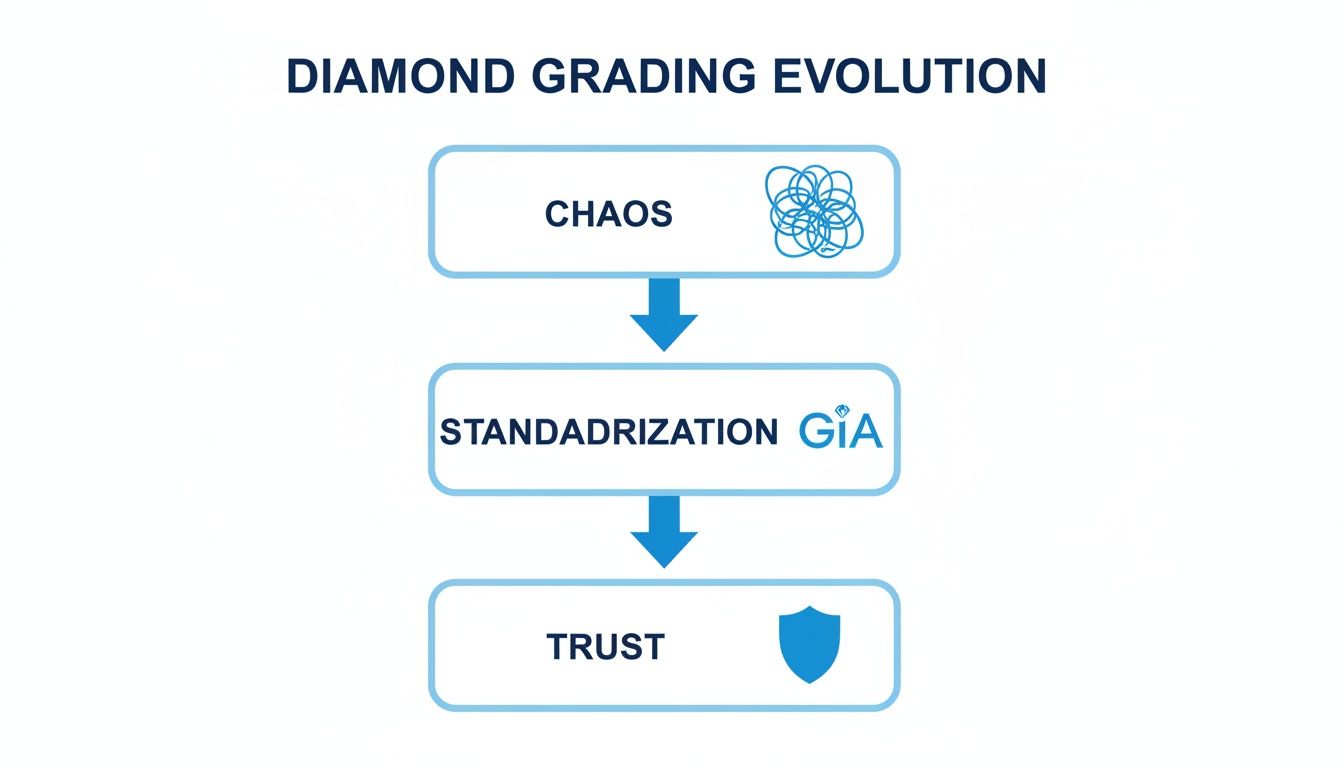
This flowchart perfectly captures how the GIA brought order to a once-chaotic industry, building the foundation of trust we rely on today.
To help you get familiar with the grades, here's a quick reference guide. We'll break down each category in more detail below.
GIA Diamond Clarity Grade Quick Reference Guide
| Clarity Grade | Meaning | Visibility (Without Magnification) |
|---|---|---|
| FL (Flawless) | No internal or external flaws. | None. The absolute pinnacle of purity. |
| IF (Internally Flawless) | No internal flaws, but may have tiny surface blemishes. | None. Visually identical to Flawless. |
| VVS1, VVS2 | Very, Very Slightly Included. Inclusions are microscopic. | None. Flaws are extremely difficult to see, even for a trained grader. |
| VS1, VS2 | Very Slightly Included. Minor inclusions are present. | Almost always "eye-clean." The best value for visual perfection. |
| SI1, SI2 | Slightly Included. Inclusions are noticeable under magnification. | Sometimes eye-clean, sometimes not. Requires careful inspection. |
| I1, I2, I3 | Included. Inclusions are obvious and often visible to the naked eye. | Yes. Flaws can impact the diamond's sparkle and durability. |
This table gives you a snapshot of what each grade means, but the real story is in the details of each category and what they mean for your ring.
Flawless and Internally Flawless (FL & IF)
Sitting at the absolute peak of the clarity scale are Flawless (FL) and Internally Flawless (IF) diamonds. These stones are the definition of perfection and are incredibly rare.
- Flawless (FL): An FL diamond has zero inclusions (internal flaws) or blemishes (external flaws) visible under 10x magnification. They are the rarest of the rare.
- Internally Flawless (IF): An IF diamond is perfect on the inside. It may have a few tiny, insignificant blemishes on the surface that could be polished away, but its internal structure is pristine.
To the naked eye, you'll never see a difference between an FL and an IF diamond. Both are stunning, but their extreme rarity places them in a collector's grade, commanding the highest prices on the market.
Very, Very Slightly Included (VVS1 & VVS2)
Next up are the Very, Very Slightly Included (VVS) grades, divided into VVS1 and VVS2. As the name implies, any inclusions in these diamonds are minuscule and incredibly difficult for even a trained gemologist to locate with a microscope.
We’re talking about tiny pinpoints or faint clouds that are completely invisible to the naked eye. A VVS diamond offers a near-perfect look without the top-tier price of a Flawless stone, making it a fantastic choice for those who want exceptional quality.
Very Slightly Included (VS1 & VS2)
The Very Slightly Included (VS) category, split into VS1 and VS2, is what many in the industry call the "sweet spot." It strikes the perfect balance between beauty and value. Inclusions in VS diamonds are still minor, like small crystals or feathers.
While a grader can spot these flaws under 10x magnification, they are almost always invisible to the unaided eye. A VS diamond looks perfectly clean once it's set in a ring, delivering the same stunning sparkle as higher-grade stones but at a much more accessible price. This is where the idea of an "eye-clean" diamond really comes into play.
An eye-clean diamond has no imperfections visible to the naked eye from a normal viewing distance. Many VS and even some SI diamonds fall into this category, representing the best value for engagement ring buyers.
Slightly Included (SI1 & SI2)
In the Slightly Included (SI) range, which includes SI1 and SI2 grades, inclusions become easier to spot under magnification. On larger diamonds (over one carat), a flaw might even be visible to someone with a very sharp eye.
Don't count them out, though! Many SI1 diamonds are still perfectly eye-clean, especially if the inclusions are off to the side where a prong can hide them. This grade can offer amazing value if you take the time to inspect the stone yourself. To see how clarity and color influence each other, take a look at our in-depth diamond clarity and color guide.
Included (I1, I2, & I3)
Finally, we have the Included (I) category, which covers I1, I2, and I3 grades. Diamonds in this range have inclusions that are obvious under magnification and almost always visible to the naked eye.
These flaws can be large enough to interfere with the diamond's brilliance and transparency, making it look cloudy or dull. In some cases, a large feather near the edge can even make the diamond more prone to chipping. While I-clarity diamonds are the most affordable, we at ECI Jewelers always recommend a thorough inspection to ensure the stone's beauty and durability aren't compromised.
A Visual Guide to Diamond Inclusions
Not all diamond imperfections are created equal. Think of them as a diamond's natural birthmarks, each telling a unique story of its formation deep within the Earth. These tiny characteristics are what make every single diamond one-of-a-kind.
These "birthmarks" are sorted into two main types: inclusions and blemishes.
Inclusions are the tiny flaws found inside the diamond. They are nature’s fingerprints, remnants from the stone's creation under immense heat and pressure. Blemishes, on the other hand, are minor imperfections on the diamond’s surface, often a result of the cutting and polishing journey. A GIA report will carefully map both.
Understanding what you're looking at is a crucial part of our "diamond clarity grades explained" guide because these features directly influence a stone's final grade and, ultimately, its beauty.
The Five Factors of Clarity Grading
When a GIA gemologist grades a diamond, they're not just counting flaws. They evaluate five specific factors to build a complete picture of the diamond’s clarity. This framework ensures every diamond is assessed consistently.
It's a common misconception that fewer flaws automatically mean a better diamond. The truth is, the size and location of an imperfection can be far more important than the total number.
For instance, a single tiny black crystal parked right under the main table facet is going to be much more visible than a larger feather tucked away near the girdle, where a prong can easily hide it.
Here are the five factors that matter most:
- Size: How big is the inclusion relative to the diamond? Larger flaws are easier to see and have a bigger impact on the grade.
- Number: This is straightforward—how many inclusions are there? A diamond with just one or two flaws will almost always grade higher than one with many.
- Position: Location, location, location. An inclusion in the center of the stone is much more impactful than one hidden near the edge.
- Nature: This describes the type of inclusion and whether it poses a risk. Is it a dark crystal that stands out, or a transparent one that blends in? A large feather near the surface could even affect the diamond's durability.
- Relief: This refers to the contrast between the inclusion and the diamond. A dark-colored inclusion has high relief, making it pop, while a white or colorless one has low relief and is harder to spot.
Key Takeaway: It’s not just about counting imperfections. It’s about how those specific flaws affect the diamond's overall beauty and structural integrity. A single, poorly placed inclusion can lower a grade more than several tiny, well-hidden ones.
Common Types of Inclusions and Blemishes
Getting familiar with the lingo on a GIA report will help you decipher its plotting diagram. While the terms might sound technical, each one just describes what the flaw looks like under 10x magnification.
Common Internal Inclusions:
- Crystals or Mineral Inclusions: These are tiny crystals of other minerals that got trapped inside the diamond as it formed. They can be black, colored, or even colorless (a diamond within a diamond!).
- Feathers: Small fractures within the diamond that look like a delicate feather. If they are large or break the surface, they can sometimes pose a durability risk.
- Clouds: A cloud is not a single inclusion but a tight group of minuscule pinpoints. A large, dense cloud can give the diamond a hazy or milky appearance, dulling its sparkle.
- Pinpoints: The most common inclusion. These are tiny black or white crystals that look like a single dot under magnification.
- Needles: Just as it sounds, a needle is a long, thin crystal that looks like a tiny rod inside the diamond. They are usually white or transparent and nearly impossible to see without a loupe.
Common External Blemishes:
- Scratches: Fine lines on a facet’s surface.
- Nicks: Small chips, usually found along the girdle or where facets meet.
- Polish Lines: Faint parallel lines that remain from the cutting and polishing wheel.
Every one of these characteristics is a piece of the puzzle that determines a diamond's final clarity grade. By understanding how gemologists see a stone, you can look beyond the paper grade and evaluate a diamond's true quality and value for yourself.
How to Choose the Right Clarity Grade for Your Budget
Knowing the GIA scale is one thing, but using that knowledge to find the most beautiful diamond for your money is the real goal here. The secret isn't about buying the highest grade you can possibly afford. It’s about finding the "sweet spot."
This is the point where a diamond appears flawless to the naked eye, even if it has minor inclusions under a jeweler's loupe.
This is the art of choosing an eye-clean diamond. It’s an industry term, not an official GIA grade, but it's the single most important concept for any savvy buyer. An eye-clean diamond gives you the exact same visual perfection as a Flawless stone but at a fraction of the cost.
This approach lets you put more of your budget toward things that have a bigger impact on sparkle—like the diamond’s cut. For more on balancing all the 4Cs, our guide on how much to spend on an engagement ring is a great place to start.
Finding the Value Sweet Spot: VS and SI Grades
For most people, the absolute best value is hiding in the Very Slightly Included (VS) and Slightly Included (SI) categories. Diamonds graded VS1 and VS2 are almost always eye-clean, making them a fantastic, safe starting point for your search.
The SI1 grade is where you can find some truly exceptional deals. Many SI1 diamonds are completely eye-clean, especially when their inclusions are small, light-colored, or tucked away near the edge. This grade does require a little more care, though. An SI2 diamond is less likely to be eye-clean, but it's not impossible to find a great one.
The key is this: you have to evaluate each diamond on its own merits. A GIA report gives you the grade, but only a visual inspection—either in person or with high-definition photos and video—can tell you if it meets your eye-clean standard.
How Diamond Shape Changes the Game
A diamond’s shape has a huge say in how well it hides inclusions. The faceting pattern can either act as camouflage for flaws or put them on full display.
-
Brilliant Cuts (Round, Princess, Oval, Cushion): Think of these shapes as masters of disguise. Their dozens of angled facets create a kaleidoscope of sparkle that breaks up the light, making it incredibly hard to spot small inclusions. You can often find stunning, eye-clean SI1 diamonds in these shapes.
-
Step Cuts (Emerald, Asscher): These shapes are more like a hall of mirrors. Their long, open facets create a crystal-clear window right into the center of the stone. There’s nowhere for inclusions to hide, so any flaw becomes much more obvious. For step cuts, it’s wise to stick to a VS2 grade or higher to guarantee a clean look.
The Impact of Carat Size
Size matters here, too. As a diamond’s carat weight goes up, its facets get bigger. This essentially creates larger “windows” that make inclusions easier to spot.
For a diamond under 1.0 carat, an SI1 grade is often a safe, budget-friendly choice that will appear perfectly clean. But once you jump up to 2.0 carats or more, those same SI1 inclusions might become visible to the naked eye. For larger stones, moving up to the VS2 or VS1 range is a smart move to maintain that eye-clean appearance.
Clarity Recommendations by Diamond Shape
To make things easier, here’s a quick-reference guide to help you choose the best-value clarity grade for your preferred diamond shape.
| Diamond Shape | Minimum Recommended Clarity (For Best Value) | Why It Matters |
|---|---|---|
| Round, Princess, Cushion | SI1 | Brilliant faceting is excellent at concealing minor inclusions. |
| Oval, Pear, Marquise | VS2 | Brilliant cuts, but pointed ends can sometimes collect inclusions. |
| Emerald, Asscher | VS2 or higher | Step-cut facets create a clear view, making flaws more apparent. |
| Radiant | SI1 | A brilliant cut that offers great sparkle and hides inclusions well. |
Ultimately, choosing the right clarity grade comes down to balancing perfection with practicality. With this knowledge, you can confidently find a diamond that delivers breathtaking beauty without breaking the bank.
Frequently Asked Questions About Diamond Clarity
As you get closer to choosing the perfect diamond, specific questions always come up. We hear them all the time at ECI Jewelers. Here are the clear, straightforward answers you need to feel completely confident in your decision.
Is a VVS Diamond Noticeably Better Than a VS Diamond?
To the naked eye, there is virtually no difference between a VVS (Very, Very Slightly Included) and a VS (Very Slightly Included) diamond. Both grades are almost always considered "eye-clean," meaning you can't see any of their internal characteristics without a jeweler's loupe.
The significant price jump you see for a VVS diamond comes down to its rarity, not a visible improvement in beauty or sparkle. For the vast majority of our clients, a well-chosen VS diamond delivers the exact same stunning look for a much better value.
Can an Inclusion Affect a Diamond's Durability?
Yes, but it's a rare concern, especially in high-quality diamonds. Certain inclusions, like a large feather (which is a tiny fracture) located near the diamond's edge or at a sharp corner on a cut like a princess, can pose a durability risk.
However, the vast majority of inclusions in diamonds graded SI and higher have absolutely no effect on the stone's structural integrity. A reputable jeweler will always inspect for these potential issues to ensure your diamond is both beautiful and built to last.
At ECI Jewelers, we meticulously examine every single diamond to rule out any durability concerns long before it ever makes it into our showroom.
What Does Eye-Clean Mean and How Do I Find It?
"Eye-clean" is a common term we use in the industry. It simply means a diamond’s inclusions are invisible to the unaided eye from a normal viewing distance, usually about 6 to 12 inches away. While it's not an official GIA grade, it's the practical goal for almost everyone buying an engagement ring.
Many diamonds in the VS1, VS2, and even SI1 grades are perfectly eye-clean. The only way to know for sure is to look at the diamond yourself, either in person or with high-definition 360° videos. The key is where the inclusion is located and what type it is—that’s what really determines if you'll achieve that flawless look.
Is Clarity Less Important in Smaller Diamonds?
Generally, yes. It's much harder to spot inclusions in smaller diamonds, particularly those under one carat. The smaller facets naturally camouflage any tiny imperfections, making it tough to see into the stone's core.
Because of this, a lower clarity grade like SI1 can look perfectly clean and offer fantastic value in a smaller diamond. As carat weight goes up, the facets get bigger—like wide-open windows—making inclusions more obvious. That's why choosing a higher clarity grade becomes more important as you shop for larger stones.
Ready to find your perfect eye-clean diamond? The experts at ECI Jewelers are here to guide you through our curated collection with transparency and care. Explore our selection and experience the ECI Jewelers difference today at https://www.ecijewelers.com.


