


At its heart, the debate over digital versus analog watches comes down to a simple choice: analog watches represent timeless artistry and lasting value, while digital watches offer modern functionality and data-driven convenience. Your decision ultimately reflects whether you prioritize heritage and personal style or the practical features of today’s technology.
The Enduring Choice: Functionality vs. Artistry
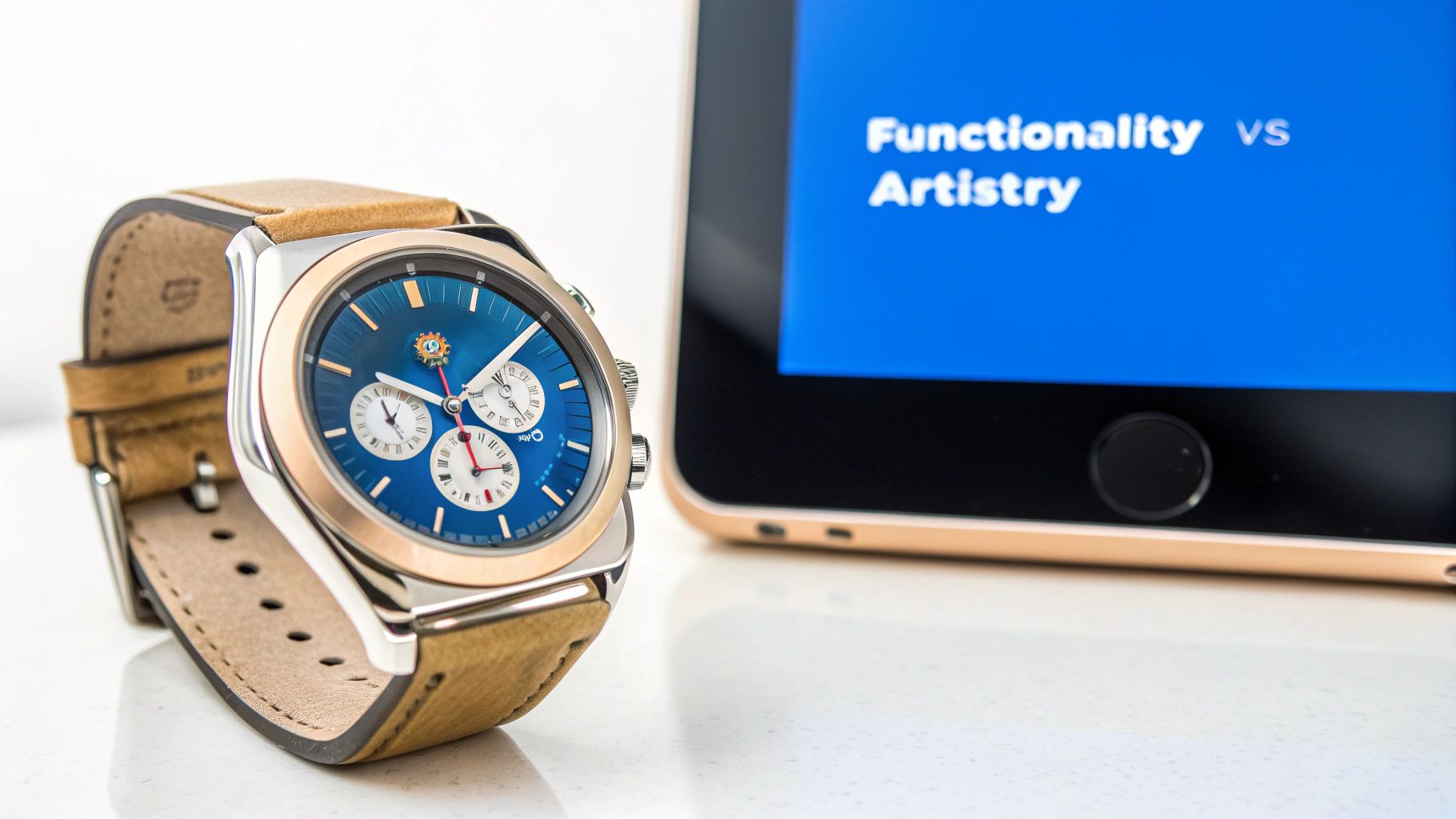
Choosing a watch is about more than just telling time. It’s a statement about your lifestyle, your priorities, and what you value. The whole digital vs. analog conversation really boils down to a trade-off between the tangible craft of traditional watchmaking and the sheer utility of modern electronics. One is an heirloom, the other is a tool.
Analog watches, with their sweeping hands and mechanical hearts, are the product of centuries of horological tradition. Wearing one connects you to a legacy of intricate engineering, painstaking assembly, and classic design. Digital watches, on the other hand, are marvels of efficiency, putting precise information on a screen and integrating seamlessly into our connected lives.
This guide will take you beyond the surface-level talking points. We'll get into the details and help you figure out which style truly fits your needs, exploring everything from the complex inner workings to their long-term value.
The decision isn't about which is "better," but which better serves your purpose. An analog watch is worn for the story it tells and the craftsmanship it represents, while a digital watch is used for the data it provides and the convenience it offers.
Analog vs. Digital: Key Differentiators
Before we dive deep, this table gives you a quick snapshot of the core differences between analog and digital watches. Think of it as a cheat sheet to the main distinctions.
| Attribute | Analog Watches | Digital Watches |
|---|---|---|
| Time Display | Hour and minute hands on a physical dial | Numeric display on an LCD or OLED screen |
| Core Technology | Mechanical (gears, springs) or quartz movement | Microprocessors, sensors, and electronic circuits |
| Primary Focus | Craftsmanship, style, and horological heritage | Multifunctionality, data tracking, and connectivity |
| Aesthetic | Classic, formal, versatile, and often luxurious | Modern, sporty, utilitarian, and tech-focused |
| Long-Term Value | High potential for value retention and appreciation | Significant depreciation; treated as consumer electronics |
| Maintenance | Requires periodic servicing for mechanical models | Requires battery replacements or charging; subject to obsolescence |
As you can see, the two are fundamentally different not just in how they look, but in their purpose, technology, and financial trajectory. Now, let’s get into what these differences mean for you.
Comparing the Inner Workings and Technology
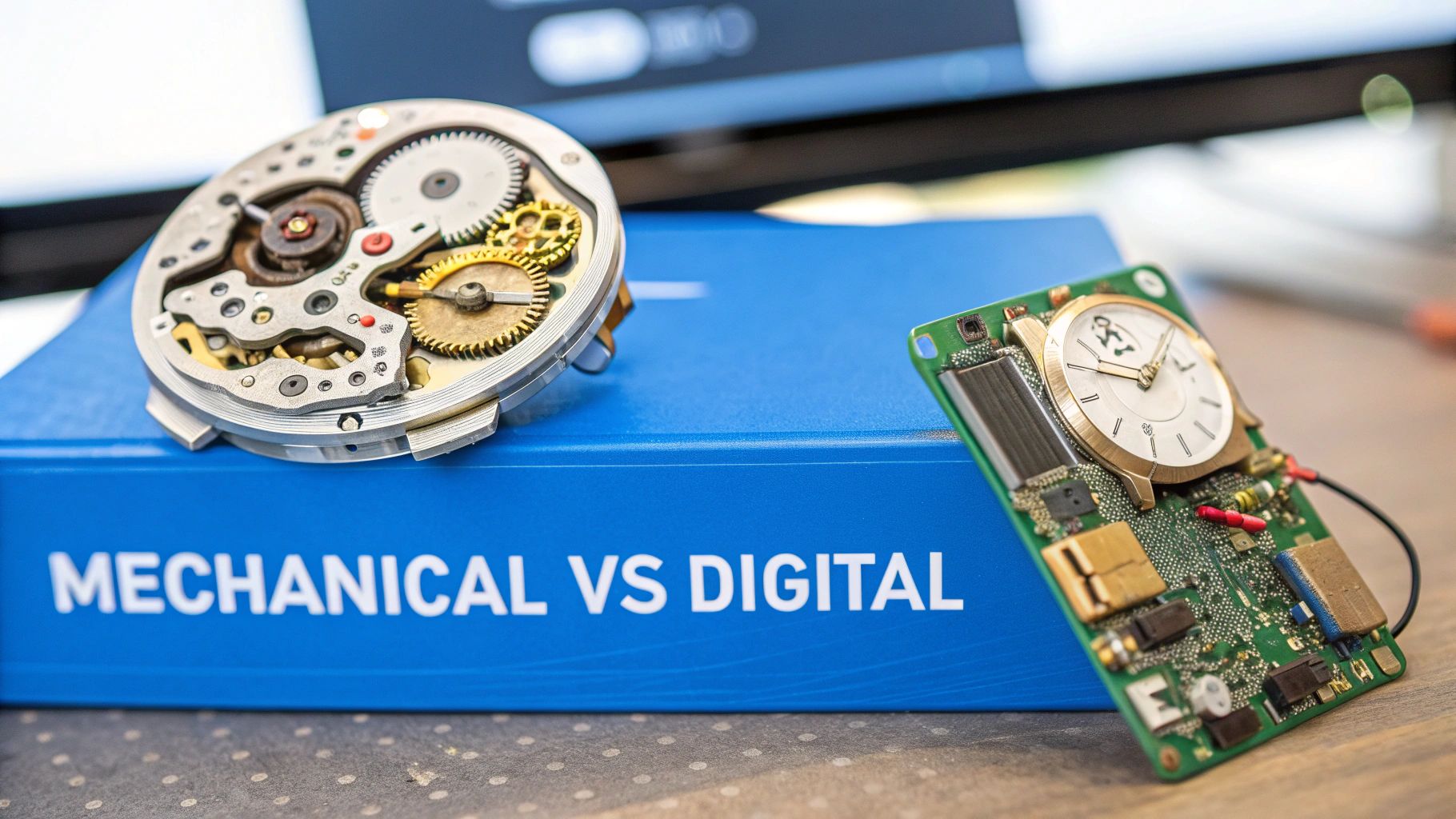
To really get to the bottom of the digital vs analog watches debate, you have to look past the dial and into the heart of the machine. One is a world of mechanical artistry, the other a realm of electronic precision. The technology inside defines everything about them, from how they feel on the wrist to what it takes to own one for the long haul.
Analog watches run on a movement—the tiny engine that powers the hands. These movements are the result of centuries of watchmaking innovation and come in two main flavors.
The Soul of the Analog Watch
At the very peak of craftsmanship, you'll find mechanical movements. These are true marvels of micro-engineering, often containing hundreds of tiny gears, springs, and jewels that work together perfectly without a single electronic part. When you think of a legendary brand like Rolex or Patek Philippe, its soul isn't just the name; it's the hand-finished movement beating inside.
The other common type of analog watch uses a quartz movement. This technology took off in the 1970s and uses a battery to send a small electrical current through a quartz crystal. That crystal vibrates at an incredibly precise frequency—32,768 times per second—which a circuit then translates into the familiar, ticking motion of the second hand.
An analog watch, especially a mechanical one, is a tangible link to horological history. Its sweeping second hand is powered by pure kinetic energy and human ingenuity—a piece of living, wearable art.
Whether mechanical or quartz, the goal of analog technology is singular: to measure the passing of time with precision and elegance. If you want to dive deeper into these power sources, you can explore the key differences between automatic and quartz movements and see how they shape a watch's character.
The Brain of the Digital Watch
Digital watches are a completely different animal. Forget gears and springs; their core is a sophisticated electronic system running on a battery. It's basically a miniature computer on your wrist.
Here’s what’s inside:
- Microprocessor: The watch's brain, which processes all the data and runs the software.
- Sensors: Modern digital watches are loaded with sensors—accelerometers, heart rate monitors, and GPS modules that track everything from your steps to your location.
- Display: Information pops up on an LCD or OLED screen, which allows for endless customization and data readouts.
- Battery: A rechargeable or replaceable battery powers all this electronic wizardry.
Because it's built on an electronic foundation, a digital watch's potential is only limited by its software and hardware. It’s not just telling you the time; it’s a data hub, a messenger, and a fitness coach rolled into one. The instant refresh of its screen gives you exact, immediate information, a world away from the smooth, continuous flow of an analog dial.
A Quick Technological Comparison
| Aspect | Analog Watch Technology | Digital Watch Technology |
|---|---|---|
| Power Source | Stored energy in a mainspring (mechanical) or a battery (quartz). | A replaceable or rechargeable battery. |
| Timekeeping | Mechanical gear train or quartz crystal oscillation. | Electronic pulses regulated by a microprocessor. |
| Complexity | Mechanical intricacy with hundreds of physical parts. | Electronic complexity with integrated circuits and software. |
| Maintenance | Mechanical models require periodic servicing; quartz models need battery changes. | Requires charging or battery replacement; subject to software updates and electronic failure. |
When you're thinking about long-term ownership, maintenance is a big deal. For battery-powered models, knowing the general cost of watch battery replacement can help you budget down the line. In the end, your choice comes down to the soul of a mechanical engine or the brain of a microprocessor—a decision that defines not just what the watch does, but what it is.
Analyzing Core Functionality and Features
When you get down to it, the digital vs analog watch debate isn't just about gears versus circuits—it's about what the watch does. This is where the two design philosophies really go their separate ways. One celebrates the intricate art of mechanical problem-solving, while the other is all about the raw utility of electronic features.
An analog watch's functionality is a direct extension of its inner workings. These aren’t "features" in the way we think of them today, but complications. These are any functions beyond basic timekeeping, all brought to life through pure mechanical engineering. A chronograph, for example, isn't just a button you press; it's a beautifully complex system of gears and levers woven into the main movement, ready to measure elapsed time at a moment's notice.
The Art of Analog Complications
The most respected analog timepieces are defined by these incredible additions. They showcase a watchmaker's skill and a brand's history, elevating a simple time-teller into a piece of sophisticated machinery.
Here are a few classic examples you'll see:
- Chronograph: This gives you stopwatch functionality, a must-have for timing events with precision. It’s the signature of legendary racing and pilot watches like the Rolex Daytona.
- Moon Phase: A stunningly artistic complication that tracks and displays the lunar cycle right on the dial. It adds a touch of romance, requiring delicate gearing to accurately follow the 29.5-day cycle.
- Perpetual Calendar: An astonishingly complex mechanism that automatically knows the length of every month, even accounting for leap years. It's a true marvel of micro-mechanical genius.
These complications aren't built for convenience. They’re built to be appreciated for the human ingenuity it took to create them. Each one adds depth, character, and a story to the watch, speaking to those who see a timepiece as functional art.
The Utility of Digital Features
Digital watches, especially smartwatches, play a completely different game. Their functionality isn't about mechanical beauty but about data, connectivity, and making daily life easier. Instead of complications, they offer a massive suite of electronic features driven by software and sensors.
This approach is all about pure utility. It turns the watch into a powerful device strapped to your wrist, designed to feed you as much useful information as possible and become a central tool for modern living.
An analog complication is a solution to a problem solved with gears and springs, showcasing mastery. A digital feature is a solution solved with code and sensors, providing data-driven convenience.
The global market certainly reflects this hunger for data. Digital watches already make up a massive $32.6 billion market in 2024, with forecasts expecting that to explode to $115.7 billion by 2034. That growth is all about smart features that track our health and keep us connected—a trend explored in recent reports on the global digital watch market.
A Head-to-Head Feature Comparison
To really see the difference in philosophy, let's look at how each type of watch handles a common task, like tracking a second time zone.
| Use Case | Analog Approach (GMT Complication) | Digital Approach (World Clock Feature) |
|---|---|---|
| How it Works | A dedicated fourth hand rotates once every 24 hours, pointing to a bezel marked with a 24-hour scale. | The user taps through a digital menu, selects a city, and the time instantly appears on the screen. |
| User Experience | A tactile, visual process. You physically set a hand against a marked bezel to track time. | A simple, software-driven task. It's fast, straightforward, and requires zero mechanical know-how. |
| Core Value | Celebrates the brilliant mechanical solution to a classic traveler's problem. | Prioritizes speed, ease of use, and instant access to hundreds of time zones. |
This breakdown shows that while both get the same job done, their methods appeal to completely different mindsets. One is about the beauty of the mechanism's journey, while the other is all about the efficiency of the result. For those curious about just how capable modern digital watches have become, you can dive deeper into the advanced health features available on smartwatches like the Apple Watch.
Ultimately, the choice in the digital vs analog watches debate comes down to a simple question: are you looking for a tool to measure moments, or an instrument built to appreciate them?
Exploring Style and Personal Expression

More than just a tool for telling time, a watch is one of the most powerful forms of personal expression you can wear. It broadcasts your values and personal taste without you ever having to say a word.
This is where the debate between digital vs analog watches becomes less about technology and more about philosophy. One is rooted in heritage and meticulous craftsmanship, the other in modern utility and adaptability.
The Timeless Appeal of Analog Design
At their core, analog watches are pieces of jewelry. Their design is a deliberate art form, where every component—from the case metal to the hands—is chosen to create a specific look and feel. The understated elegance of stainless steel or the warm glow of rose gold sets the tone instantly.
The dial is a canvas for details you can get lost in, like intricate guilloché patterns, hand-applied indices, or perfectly lumed hands. It's this timeless, artistic appeal that allows a classic timepiece to elevate any outfit.
Analog watches offer a rich tapestry of styles, each with its own history. This variety lets you find a piece that perfectly aligns with your personal brand, whether you’re closing a deal in the boardroom or relaxing on a sailboat.
Just look at these iconic styles:
- The Dress Watch: A piece like the Cartier Tank defines formal elegance. Its clean lines and minimalist dial signal pure sophistication, making it the essential accessory for formalwear. You can learn more about what defines a classic dress watch and why it's a wardrobe staple.
- The Dive Watch: The Rolex Submariner, with its rugged build and rotating bezel, projects an image of adventure and capability. It’s a legendary tool watch that has become a status symbol, looking just as good with a wetsuit as it does with a business suit.
- The Pilot's Watch: Models like the Breitling Navitimer boast complex, function-driven dials that speak to a history of aviation and precision. They’re bold, confident, and unapologetically technical.
This deep design heritage is a huge reason analog watches command such a powerful presence. In the U.S. alone, analog timepieces hold a staggering 93.46% revenue share in 2024. That market dominance reflects a profound appreciation for the artistry and legacy that brands like Rolex, Omega, and Patek Philippe—all staples at ECI Jewelers—represent.
The Modern Versatility of Digital Aesthetics
Digital watches come at style from a completely different angle: versatility and function. Their aesthetic is typically modern and utilitarian, defined by materials like resin, aluminum, and titanium. Instead of a fixed design, they offer a blank screen.
The main stylistic feature of a digital watch is its customizable face. With a few taps, you can swap a data-heavy dashboard for your workout with a minimalist analog-style dial for dinner. This chameleon-like ability is its greatest strength, letting it adapt to your mood and needs on the fly.
An analog watch is a statement piece with a fixed identity, reflecting a legacy of design. A digital watch is a functional canvas, changing its identity to match the context of the moment.
But this versatility has its trade-offs. While you can mimic classic designs, a digital screen can never truly capture the depth, texture, and light play of a physical dial with hand-applied indices and polished hands. It's a representation of a style, not the style itself.
When you pair a luxury analog watch from ECI Jewelers with fine jewelry, you create a cohesive and elevated look that a tech-focused device struggles to match. The deliberate choice of an analog piece—its history, materials, and design—makes a far more profound style statement.
Understanding Long-Term Value and Legacy
When you get past the immediate bells and whistles in the digital vs analog watches debate, the conversation shifts to something more profound: long-term value. This is where you see the fundamental divide in philosophy. One is a piece of consumer electronics, built for the now; the other is a mechanical heirloom, crafted for generations.
A digital watch, no matter how advanced, is tied to the rapid lifecycle of technology. Its value is front-loaded, based entirely on its current software and hardware. In just 3-5 years, battery decay and outdated tech make it less useful, and it's quickly replaced by the next model.
A high-quality mechanical analog watch, on the other hand, is built for permanence. It’s not meant to be disposable—it’s meant to be maintained. With proper care, a well-made timepiece from a house like Rolex or Patek Philippe will easily outlive its first owner, becoming a tangible piece of family history passed down to the next generation.
The Dynamics of Resale and Appreciation
The financial journey of these two watch types couldn't be more different. Digital watches depreciate like a rock, just like a new smartphone or laptop. Their resale value is minimal because newer, better versions are always just around the corner, making older ones functionally obsolete.
Mechanical analog watches, especially from respected Maisons, often follow the opposite path. Many hold their value incredibly well, and some appreciate significantly over time. This elevates them from a simple purchase to a genuine asset class.
A digital watch is an expense; a luxury analog watch can be an investment. The former loses value from the moment you open the box, while the latter has the potential to grow in worth, becoming a store of value on your wrist.
This isn’t just collector talk; it’s a proven market reality. North America is a powerhouse for fine watchmaking, where analog watches claim a staggering 97.49% revenue share in 2024. This market dominance shows why legacy brands are so enduring. In fact, certain Rolex models have seen appreciation of 10-20% annually, making them a legitimate consideration for any serious portfolio. You can see how deeply rooted this trend is by looking at how analog watches dominate the North American market.
Built to Last A Legacy of Durability
The idea of legacy is tied directly to physical endurance. Luxury analog watches are engineered from the ground up for longevity, using materials chosen for both their beauty and their resilience. A solid case made of high-grade stainless steel or precious metal provides a fortress for the intricate movement inside.
Perhaps the most crucial element is the watch crystal. Top-tier analog watches almost always use sapphire crystal, a material that is second only to diamond in hardness. This makes them virtually impossible to scratch, ensuring the dial stays crisp and clear for decades.
In contrast, the screens on digital watches are far more fragile. Even when made of hardened glass, they're susceptible to the scratches and cracks of daily life. A damaged screen often signals the end of the watch's useful life, since repairs are either impractical or too expensive. If you're weighing the financial side of things, understanding the nuances of investing in luxury watches is a critical next step.
Here’s a look at how their construction philosophies stack up:
| Durability Aspect | Luxury Analog Watches | Digital Watches |
|---|---|---|
| Case Material | Often crafted from 316L or 904L stainless steel, titanium, gold, or platinum for maximum resilience. | Typically made from aluminum, plastic, resin, or sometimes titanium for a lightweight, functional build. |
| Crystal/Screen | Utilizes synthetic sapphire crystal, which is exceptionally hard and resistant to scratches. | Employs hardened mineral glass or proprietary materials that are more prone to scratching and shattering. |
| Water Resistance | Engineered with screw-down crowns and case backs, often rated for depths of 100 meters or more. | Varies widely, from basic splash resistance to ratings suitable for swimming, but rarely matches high-end dive watches. |
| Repairability | Designed to be serviced and repaired indefinitely by skilled watchmakers, with parts available for decades. | Limited repair options; often cheaper to replace the entire unit than to fix a major electronic or screen issue. |
Ultimately, the choice between digital vs analog watches boils down to your perspective. If you need a functional tool for today, a digital watch makes perfect sense. But if you want a lasting symbol of craftsmanship, an appreciating asset, and a piece of your own history to pass on, the enduring value of an analog timepiece is simply unmatched.
How to Choose the Right Watch for You
Choosing between a digital and an analog watch isn't about which one is universally "better." It’s about figuring out what you actually need from a timepiece and how it fits into your life. The right watch should feel like an extension of your personal style and daily routine.
This decision tree helps cut through the noise, mapping out the core questions that lead you to the right type of watch.
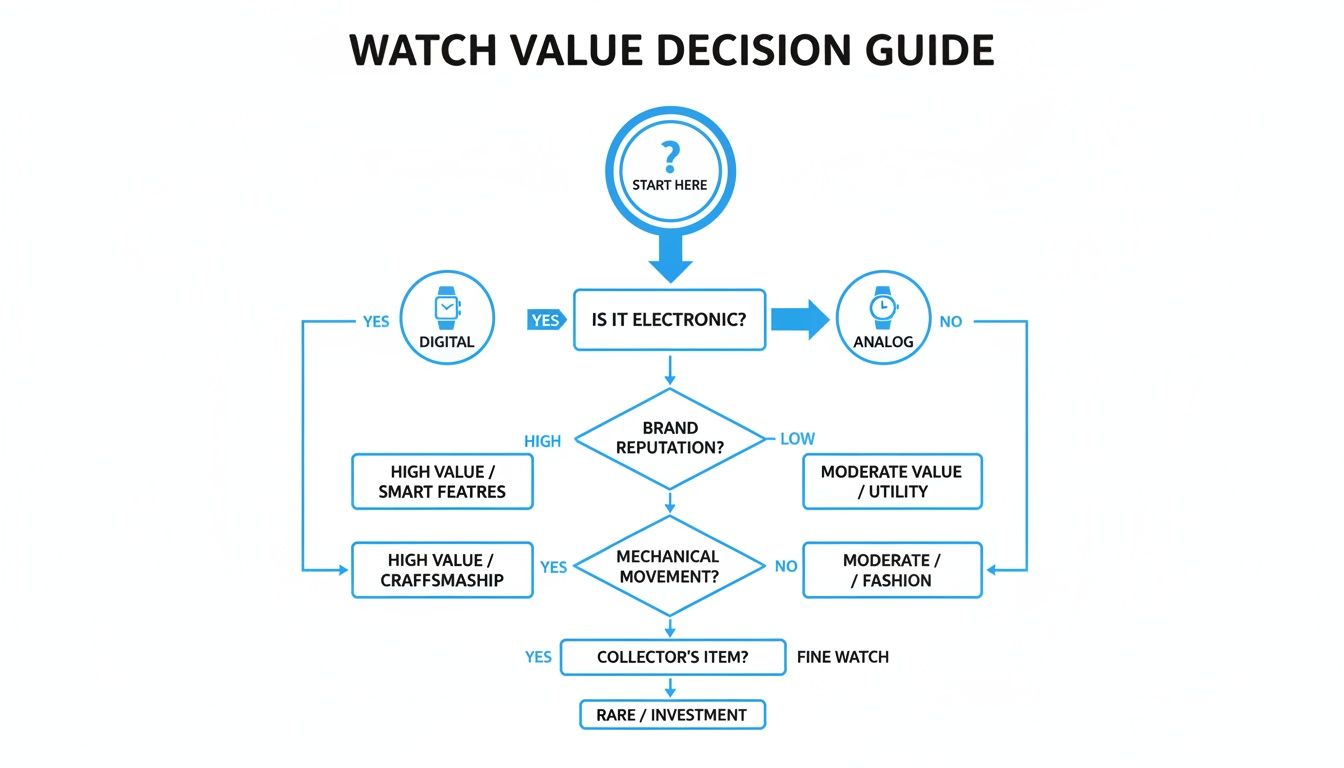
As you can see, the path splits right away. Are you after data and connectivity, or are you looking for craftsmanship and lasting value? To make it even clearer, let's break it down by who you are and what you do.
The Modern Athlete and Tech Enthusiast
If your world runs on performance data, seamless connectivity, and everyday utility, a digital watch is your perfect partner. You need a device on your wrist that tracks your runs, monitors your health, and keeps you plugged into your digital life without missing a beat. For you, functionality trumps tradition.
A high-performance smartwatch is a no-brainer here:
- Data-Driven Insights: Get instant feedback on your heart rate, GPS location, sleep quality, and daily steps.
- Convenience: Handle notifications, make payments, and launch apps right from your wrist. It's an essential tool.
- Adaptability: Swap out your watch face and features to match what you're doing, whether you're at the gym or out with friends.
Simply put, a digital watch is a tool for the here and now. It excels at delivering information and making an active life easier.
The Executive and Style-Conscious Professional
For those who command a boardroom, a luxury analog watch is a key piece of their professional identity. Your watch needs to do more than tell time—it has to signal taste, accomplishment, and an appreciation for things that last.
A timepiece like a Patek Philippe Calatrava or a Rolex Datejust doesn't just tell time; it communicates a commitment to excellence and heritage. It's a non-verbal cue that signals attention to detail and a respect for tradition.
In the professional world, a classic analog watch is:
- A Symbol of Sophistication: It’s the finishing touch on professional attire, elevating your personal brand.
- An Icon of Craftsmanship: It shows you value the artistry and precision of true horology.
- A Conversation Starter: A beautiful mechanical watch often has a story, connecting you with fellow enthusiasts.
For professional milestones and formal events, the quiet confidence of a luxury analog watch speaks volumes where words can't.
The Discerning Collector and Investor
The collector sees a watch as more than an accessory—it's a hard asset and a piece of history. You're hunting for rare references, you appreciate mechanical ingenuity, and you know what makes a timepiece hold its value for generations. Your focus is on legacy.
This kind of buyer naturally gravitates toward mechanical analog watches from the most prestigious makers, prioritizing:
- Horological Significance: The history, innovation, and brand heritage behind the watch are paramount.
- Investment Potential: Certain models are known for their rarity and strong performance on the secondary market.
- Enduring Legacy: You're buying a functional piece of art that can be passed down.
For anyone looking to build a personal legacy or a diverse portfolio, a curated collection of authenticated analog watches is the undisputed choice. At ECI Jewelers, our experts are here to help you find the pieces that align perfectly with your collection and investment goals.
Questions We Hear All the Time
When you're weighing a digital watch against an analog one, a few key questions always come up. Here are the straight answers to help you decide what really matters to you, cutting through the noise about value, upkeep, and purpose.
Is an Analog Watch a Good Investment?
Absolutely. While most things you buy lose value the second you walk out the store, the right analog watch is different. Certain luxury models from iconic brands like Rolex and Patek Philippe often hold their value—and in many cases, increase over time.
It all comes down to a few key factors: brand prestige, how rare the model is, its condition, and any history attached to it. Some references become hot collectibles, appreciating significantly on the secondary market. At ECI Jewelers, our experts can give you a valuation to help you understand the investment potential of a timepiece, making sure your purchase is something you love to wear and a smart financial move.
What Costs More to Maintain: Analog or Digital?
The costs aren't really comparable because you're paying for two totally different things. A digital watch might just need a new battery every couple of years, but its real cost is that it becomes obsolete. When the tech is outdated or the electronics fail, you just replace the whole thing.
A high-quality mechanical watch requires periodic servicing, typically every 5-10 years. This isn’t just a repair; it’s a strategic investment in preserving the function, accuracy, and value of a mechanical heirloom for generations to come.
This service is all about preserving the intricate movement and ensuring it lasts a lifetime—or several. ECI Jewelers offers professional servicing with genuine parts, so your timeless investment runs just as it should.
Why Buy an Analog Watch When a Smartwatch Does More?
This is the big one, and it really gets down to purpose. A smartwatch is a utility gadget. It’s built for tracking data, pushing notifications, and keeping you connected. It’s incredibly useful, but it's also disposable tech meant for daily tasks.
A luxury analog watch, on the other hand, is a piece of wearable art. It serves a completely different—and more lasting—purpose. Think of it this way:
- It’s a Symbol: It represents craftsmanship, heritage, and personal achievement.
- It’s Horological Art: You're wearing a piece of engineering history on your wrist.
- It’s Timeless Style: It’s an elegant statement that won’t be outdated by next year's software update.
An analog watch is a statement of legacy, not just a tool for the moment.
At ECI Jewelers, we believe a fine timepiece is more than just an accessory—it's a legacy. Explore our curated collection of authenticated luxury analog watches and find the perfect expression of your style and values. Visit us at https://www.ecijewelers.com.


