


Chrono24's 2024 data overturns the old idea that women's luxury watches must be tiny, decorative, and quartz-powered. Thirty-two percent of watches bought by women worldwide had cases measuring 40 mm or larger, rising to 47% in the United States, while one in three watches purchased by women on the platform was a Rolex, according to Chrono24's women's watch market coverage. The right purchase now depends on fit, mechanics, daily use, and resale logic, not a marketing label. This guide separates the popular luxury watches for women into practical style families, explains sizing and movement tradeoffs, and gives authenticated pre-owned price references so you can buy with confidence.
The Four Main Style Families of Women's Luxury Watches
Start with the watch's job, not its diameter. The popular luxury watches for women fall into four useful families: dress watches prioritize slim profiles and formal elegance, sport watches deliver automatic mechanics and daily durability, diamond and gem-set watches make stones part of the design, and everyday crossover pieces move between work, travel, and weekends without looking out of place.
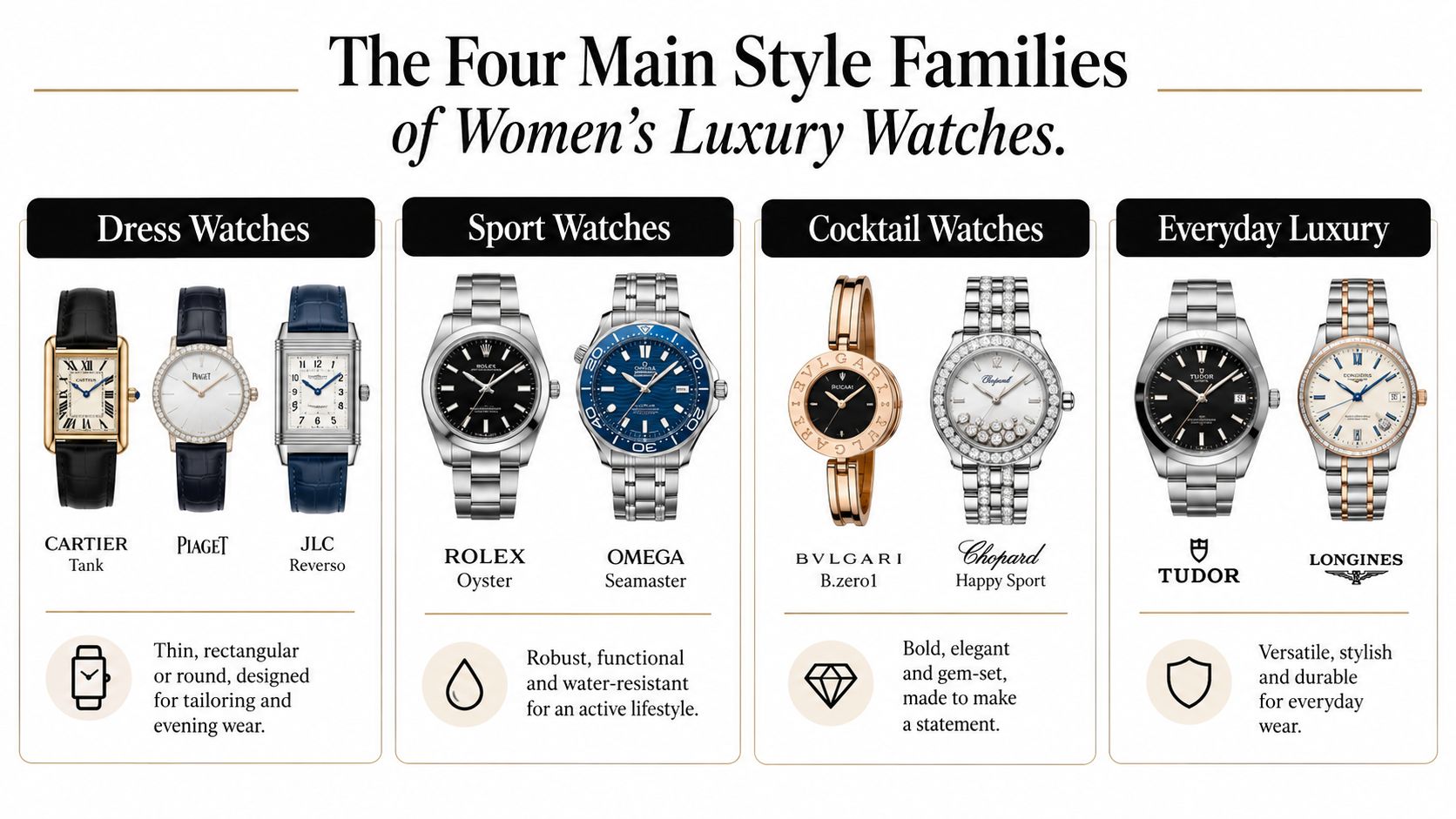
Dress watches
The Cartier Tank, Piaget Altiplano, and Jaeger-LeCoultre Reverso belong here. Their appeal comes from proportion, thinness, and a case shape that works with tailoring, evening clothes, and understated jewelry. The Cartier Tank Solo is especially direct. Its quartz movement, 27.40 mm steel case, and 30 m water resistance favor low maintenance and a discreet profile, as documented by WorldTempus' Tank Solo specifications.
Sport watches
The Rolex Lady-Datejust, Omega Seamaster Aqua Terra, and Rolex Yacht-Master occupy the more capable lane. Automatic movements, stronger water resistance, and bracelets built for repeated wear make them better choices for someone who wants one watch to handle office hours, travel, and active weekends.
Diamond and gem-set watches
A diamond watch should look intentional, not like a standard case modified after purchase. Consider a factory-set Rolex Datejust, Patek Philippe Twenty~4, Audemars Piguet Royal Oak 33 with pavé work, or Chopard Happy Diamonds when the stones are central to the design. Buyers who want a broader jewelry wardrobe can also use this classic dress watch guide to compare formal watch proportions with other fine accessories.
Everyday crossover watches
The Cartier Ballon Bleu 33, IWC Portofino Automatic 34, and Tudor 1926 are the sensible middle ground. They have enough refinement for a meeting, enough restraint for daily wear, and enough flexibility to work with leather, steel, or alternative straps.
Choose the family first. Then evaluate the wrist fit, movement, metal, and market value inside that lane.
How Sizing and Fit Actually Work on Smaller Wrists
Case diameter tells only half the story. Lug-to-lug length controls whether a watch sits neatly across the wrist or overhangs it, which is why a 36 mm case with short lugs can wear smaller than a 31 mm model with long ones. A practical women's watch sizing guide makes the same point, emphasizing lug-to-lug alongside diameter.
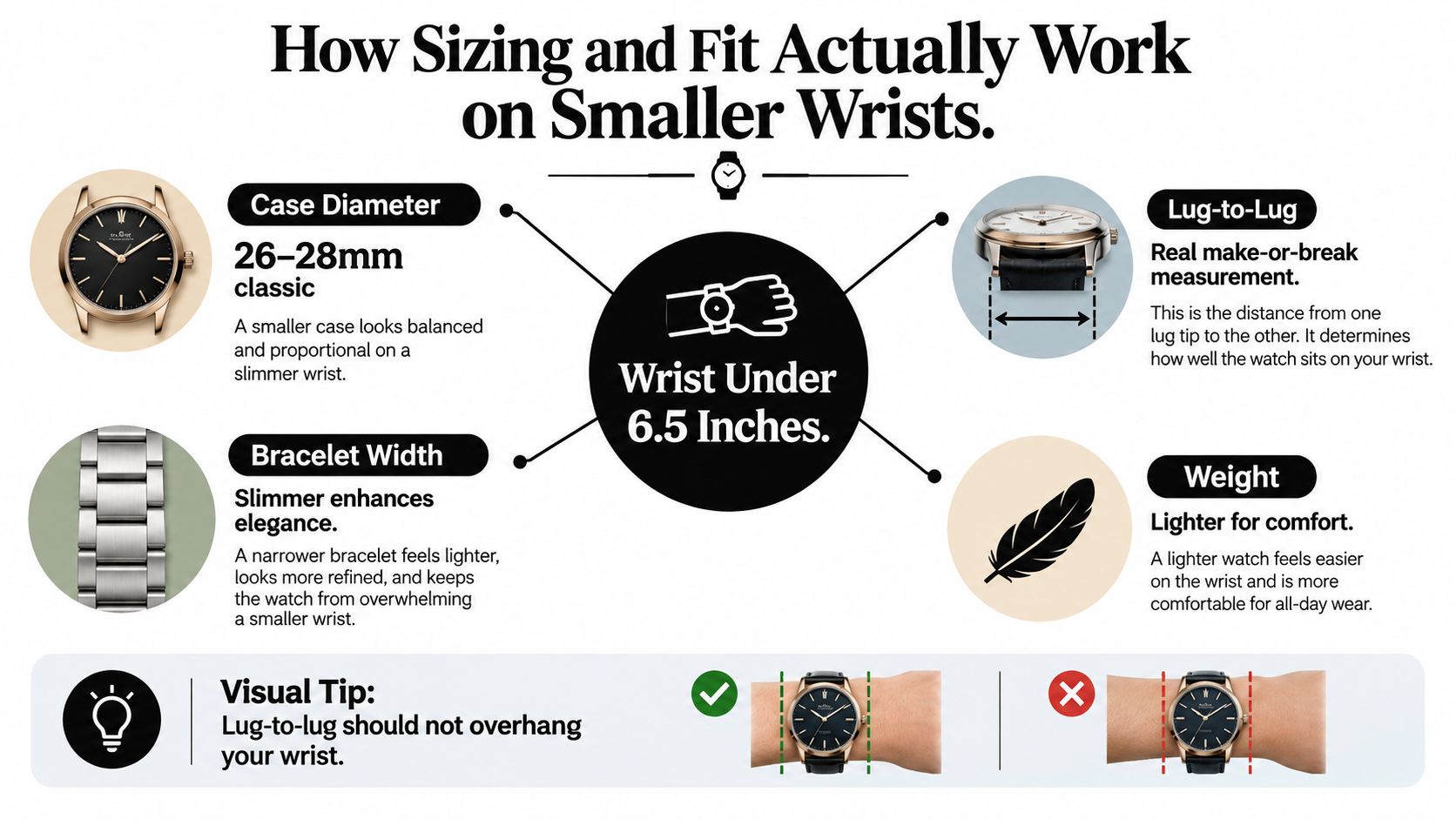
For wrists under 6.5 inches, use three practical tiers:
- 26 to 28 mm classic: Cartier Tank and Rolex Lady-Datejust references create a compact, traditional profile.
- 31 to 34 mm balanced: Omega Aqua Terra 34, Cartier Ballon Bleu 33, and IWC Portofino 34 offer stronger legibility without looking oversized.
- 36 to 39 mm modern bold: Datejust 36 and Yacht-Master 37 give the wrist more authority and align with the move toward unisex sizing.
The coin analogy helps before you visit a dealer. A 26 mm watch is close to a nickel, a 34 mm watch resembles a quarter, and a 39 mm watch approaches a half-dollar in visual presence. It isn't a substitute for trying the watch on, but it gives you a useful starting point.
Bracelet architecture changes the result. An Oyster bracelet keeps a watch visually lean, while a fluted bezel and Jubilee bracelet add texture and make the same case feel more prominent. President, integrated, leather, and Milanese styles also alter how the watch fills the wrist. If you're comparing bracelet and strap options, this guide on how to choose watch straps is useful for understanding how material changes comfort and proportion.
Measure your wrist with a soft tape, record the circumference, and ask for the candidate's lug-to-lug length before shortlisting it. For bracelet adjustment principles, consult this guide to sizing a watch bracelet.
Iconic Dress and Sport References Worth Knowing
The strongest popular luxury watches for women divide into two philosophies. Dress watches win through shape and restraint. Sport watches win through mechanical capability and resistance to daily abuse. The best choice depends on whether you want the watch to disappear beneath a cuff or stay visible as part of the outfit.
The Cartier Tank Solo is the cleanest dress option for a buyer who values convenience. Its quartz movement, 27.40 mm steel case, and 30 m water resistance make it slim and easy to maintain. A mechanical Tank Française brings more horological interest and a stronger bracelet presence, but the Tank Solo remains the more practical grab-and-go piece.
For mechanical dress watch buyers, the Piaget Altiplano 34 mm is the specialist's choice. It prioritizes extra-thin construction over water resistance and casual toughness. The Jaeger-LeCoultre Reverso Classic Monoface takes a different route, using a manually wound movement and a reversible case that remains one of the most distinctive silhouettes in luxury watchmaking.
The sport side of the decision
The Rolex Lady-Datejust 28 is the safest all-round recommendation for a buyer who wants recognition, durability, and a compact case. Rolex introduced the Lady-Datejust in 1957 as a women's expression of the Datejust family, a move that positioned performance watchmaking as relevant to women as well as men, as described in this history of iconic women's watches.
The Omega Seamaster Aqua Terra 34 mm is the value-focused technical alternative. It offers a more overtly sporty design and greater water resistance than a Tank, while remaining appropriate with formal clothing. The Rolex Yacht-Master 37 is the luxury-sport choice, particularly in Rolesor, but its broad bezel and bracelet presence make it wear larger than the number suggests.
| Model | Style | Case Size | Movement | Water Resistance | Starting Retail (USD) |
|---|---|---|---|---|---|
| Cartier Tank Solo | Dress | 27.40 mm | Quartz | 30 m | Not stated |
| Cartier Tank Française | Dress-sport | Not stated | Automatic | Not stated | Not stated |
| Piaget Altiplano | Extra-thin dress | 34 mm | Automatic | Not stated | Not stated |
| Jaeger-LeCoultre Reverso Classic Monoface | Reversible dress | Not stated | Manual | Not stated | Not stated |
| Rolex Lady-Datejust 28 | Sport-luxury | 28 mm | Calibre 2236 | 100 m | Not stated |
| Omega Seamaster Aqua Terra | Everyday sport | 34 mm | Automatic | 150 m | Not stated |
| Rolex Yacht-Master | Sport-luxury | 37 mm | Automatic | 100 m | Not stated |
Quartz is the lower-maintenance route, while automatic movements offer mechanical depth and stronger enthusiast appeal. For broader Rolex comparisons, use this guide to the most popular Rolex models.
Diamond, Gem-Set, and Jeweled Watch Considerations
Diamond watches come in three distinct configurations. A factory diamond dial preserves the brand's original design and documentation. An aftermarket diamond bezel can change the appearance dramatically but demands close inspection. A full pavé or jewelry-case setting treats the watch as a high-jewelry object first and a timekeeper second.
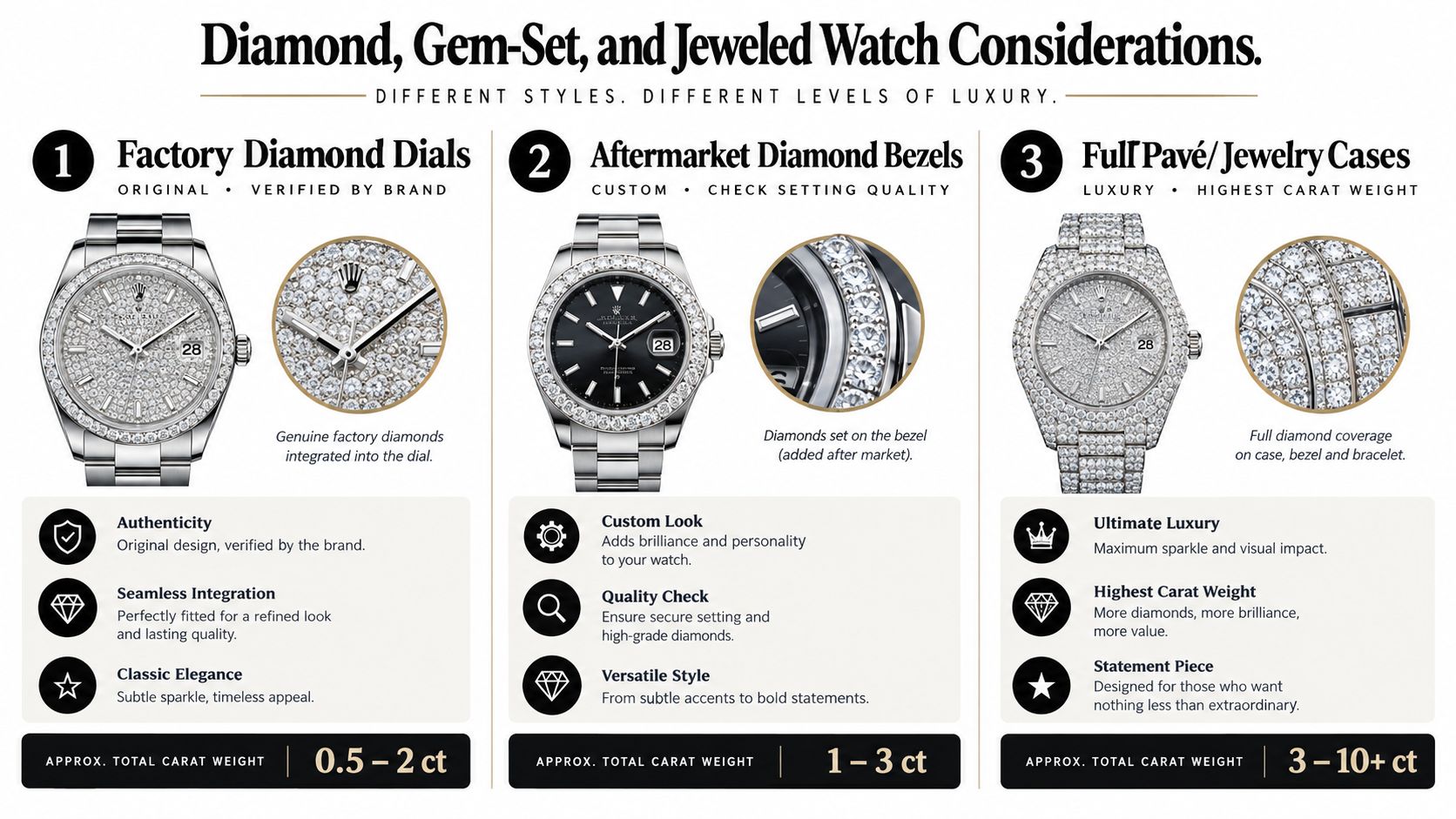
Setting style affects both price and wearability. Channel settings sit stones in a continuous groove and reduce exposed edges. Prong settings create more light play but can catch on knitwear. Invisible settings produce a smooth surface and demand especially careful inspection if the watch is pre-owned.
A Rolex Datejust 31 with a factory diamond dial and Jubilee bracelet commonly falls around 1.5 to 3.0 total carats, while a Cartier Tank Française with a diamond bezel is approximately 0.70 to 1.0 total carat, based on the configurations described in the market brief. Those figures aren't interchangeable with a watch's resale value. Brand provenance, setting quality, metal, condition, and original documentation matter just as much.
Treat an aftermarket bezel as a separate buying decision, not a shortcut to factory luxury. Check whether the work is documented, whether stones match in color and cut, and whether the setting has altered the case. Buyers exploring a broader statement jewelry collection for women should apply the same discipline to craftsmanship and wearability.
Natural and lab-grown diamonds also create different resale conversations. A factory configuration with complete paperwork is easier to explain in the secondary market than an undocumented modification, regardless of the stone's origin. For practical guidance on stone-set cases, see this guide to diamond watch bezels.
What Women Are Buying in 2026
Women's buying behavior has moved well beyond the 26 mm quartz stereotype. Chrono24 data reported that 32% of watches bought by women worldwide in 2024 measured 40 mm or larger, with the United States reaching 47%. A separate summary found women's share of purchases in that size category rising from 21% in January 2019 to 35% by December 2023. Women also represented 64% of buyers for watches priced at EUR 20,000 or more and measuring at least 40 mm, according to National Jeweler's summary of the Chrono24 study.
The buying pattern favors automatic sport watches, two-tone cases, yellow gold, and authenticated pre-owned references. Small watches still have a clear role, especially for formal wear. The stronger recommendation is to choose by design and wrist fit rather than by a gender label. Cartier Tanks, Rolex Datejusts, Omega Constellations, Tudor Black Bay references, and larger unisex sports watches all earn consideration.
| Reference | Typical Size Mentioned in the Brief | Movement Direction | Buying Signal |
|---|---|---|---|
| Rolex Datejust | 31 mm and larger options | Mechanical sport-luxury | Strong interest in classic configurations |
| Rolex Oyster Perpetual | Larger unisex sizing | Automatic | Clean everyday appeal |
| Cartier Tank | Small and larger formats | Quartz or mechanical by variant | Design-led demand |
| Cartier Ballon Bleu | 33 mm crossover size | Automatic or quartz by variant | Office-to-evening versatility |
| Omega Constellation | Smaller jewelry-watch sizes | Automatic or quartz by variant | Gem-set and mechanical options |
| Tudor Black Bay | Mid-size unisex sizing | Automatic | Growing sport-watch appeal |
Deloitte's 2024 Swiss watch industry research adds useful movement and budget context. More than 50% of women surveyed either wore only a smartwatch or alternated between smart and traditional watches, while 22% wore only a traditional watch. Almost 40% of female consumers said they would spend between USD 501 and USD 5,000 on a new watch, up 10 percentage points from 2023, according to Deloitte's Swiss watch industry research.
The practical takeaway is clear: women are choosing credible watches across dress, sport, and jewelry categories, including larger mechanical references. For younger buyers and dress-watch preferences, review this overview of Gen Z luxury watch trends.
Real Market Prices for the Most Popular References
The secondary market is where the differences become concrete. Vintage stainless-steel Lady-Datejust models remain among the easiest Rolex entry points, with cited ranges beginning around $3,000 to $5,000. Current-generation 28 mm references trade roughly between $6,000 and $10,000, while two-tone Rolesor examples commonly sit around $8,000 to $18,000, according to this women's Rolex pricing guide.
Other ranges in the market brief are useful as budgeting guides, but they aren't promises. A full set with original papers can command more confidence than a watch-only deal. Diamond-set versions need an even closer review because factory originality and aftermarket work produce very different resale outcomes.
| Reference and Configuration | Pre-Owned Price Range (USD) | Notes |
|---|---|---|
| Vintage stainless-steel Lady-Datejust | $3,000 to $5,000 | Entry route into Rolex ownership |
| Current-generation Lady-Datejust 28 mm | $6,000 to $10,000 | Condition and configuration drive the spread |
| Two-tone Rolesor Lady-Datejust | $8,000 to $18,000 | Gold content and bracelet matter |
| Rolex Lady-Datejust 28 steel | $7,500 to $12,000 | Broader current pre-owned range |
| Rolex Lady-Datejust 28 two-tone | $18,000 to $28,000 | Configuration dependent |
| Solid-gold Lady-Datejust with diamond dial | $35,000 to $55,000 | Factory setting and condition are critical |
| Cartier Tank Française small steel | $4,500 to $6,500 | Compact dress-sport profile |
| Cartier Tank Française medium steel | $6,000 to $8,500 | More wrist presence |
| Cartier Tank Française diamond-set | Above steel equivalent | Diamond versions may add 40% to 80% |
| Cartier Ballon Bleu 28 to 33 mm steel | $4,200 to $7,000 | Strong everyday crossover option |
| Omega Constellation 28 mm steel | $4,500 to $7,500 | Bracelet and dial configuration matter |
Don't negotiate only on the headline price. Ask whether the watch includes its original box, warranty card, service documentation, and matching reference information. A cheaper watch with unclear provenance can cost more after authentication, servicing, or parts replacement.
How to Buy Pre-Owned With Confidence
A pre-owned watch earns its value through original parts, correct finishing, documented provenance, and a clear return policy. The buyer's task is to verify each one before money changes hands.
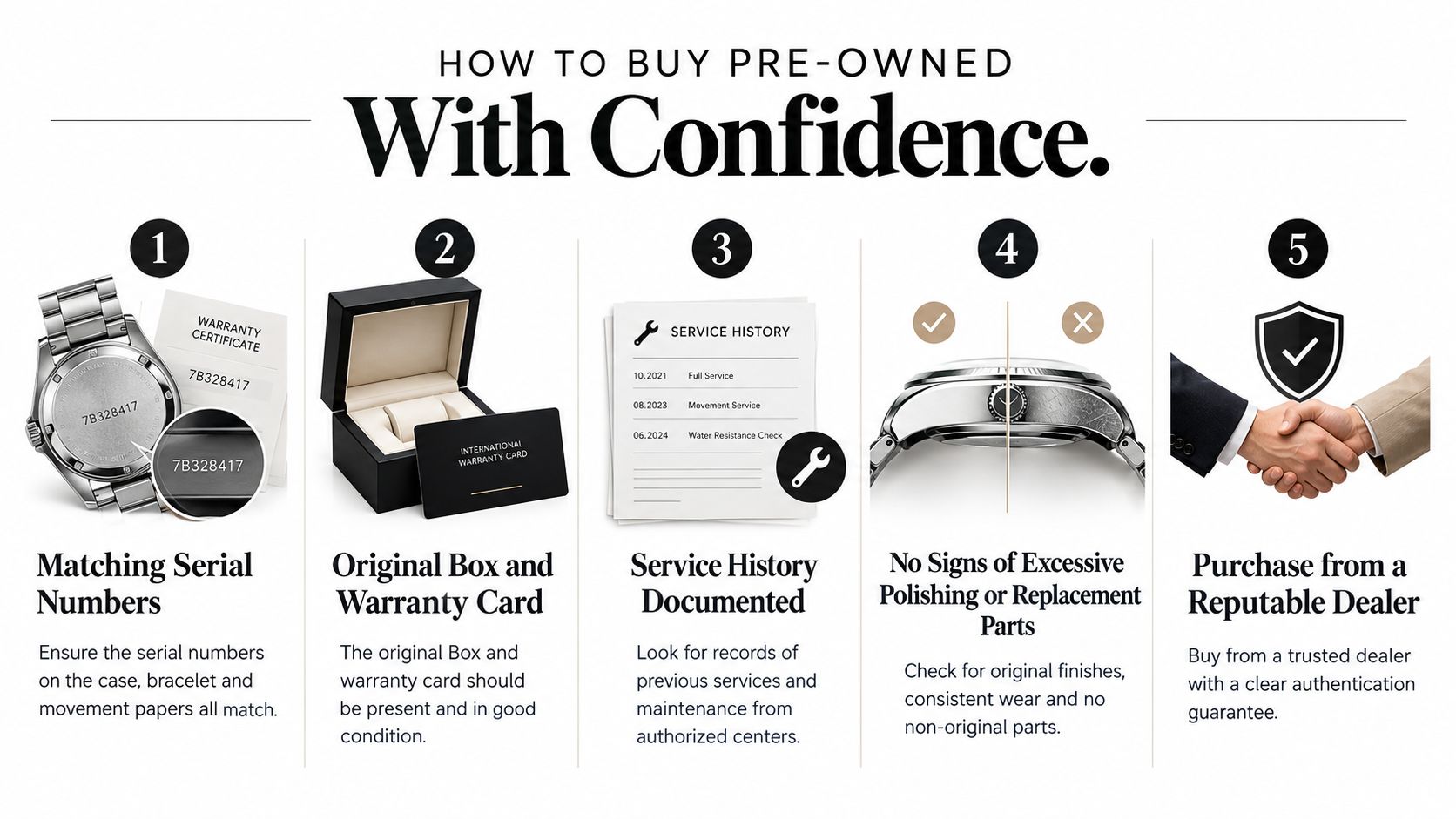
Five non-negotiable checks
- Match the serial information. Case, bracelet, movement records, and papers should tell one consistent story. Mismatches can indicate swapped parts or a composite watch.
- Review the box and warranty card. The reference, date information, and card details should align with the watch. Missing accessories don't automatically make a watch false, but they affect confidence and pricing.
- Demand documented service history. An authorized service record or credible watchmaker report gives you evidence about maintenance and previous repairs.
- Study the finishing. Sharp factory edges should remain sharp. Soft lugs, rounded bevels, uneven brushing, or an over-polished bezel deserve a price adjustment or a pass.
- Get a written return policy. You should have time to arrange an independent inspection. A seller who discourages outside review isn't offering the transparency a serious purchase requires.
Aftermarket diamonds, redials, water damage, and replacement bracelets can hide behind attractive photographs. An independent watchmaker should be able to assess movement condition, case geometry, water resistance, and functional performance without pressure.
ECI Jewelers describes a process involving in-house inspection, accuracy and water-resistance testing, and third-party authentication from independent watchmakers before listing pre-owned pieces. That model is the standard to look for in a serious NYC Diamond District transaction.
The following video offers additional visual context for evaluating pre-owned luxury watches.
Choosing the Right Watch and Buying It the Right Way
Use a three-part decision. First, choose the style family that matches your wardrobe and routine. Second, select the case and lug-to-lug dimensions that sit comfortably. Third, decide whether current production or authenticated pre-owned ownership gives you the better combination of budget, rarity, and condition.
A dress buyer should start with the Cartier Tank, Piaget Altiplano, or Reverso rather than forcing a sports watch into formal settings. A daily-wear buyer should look at the Lady-Datejust, Aqua Terra, Ballon Bleu, or another mechanically credible crossover piece. A collector who wants visual impact can move into a diamond-set Datejust, Royal Oak, Patek Philippe Twenty~4, or a carefully verified high-jewelry configuration.
The strongest purchase isn't automatically the smallest or most expensive. It's the watch whose mechanics, dimensions, finishing, and provenance match how you live. Authenticated pre-owned buying can also open access to discontinued references, older dial executions, and configurations that are no longer easy to source at retail.
ECI Jewelers offers authenticated women's watches from brands including Rolex, Cartier, Audemars Piguet, Patek Philippe, Omega, and Tudor, along with buying, selling, trade-in, servicing, and concierge sourcing. Visit ECI Jewelers with a specific target, such as a Lady-Datejust, diamond-set Cartier Tank, or discontinued Omega reference, and ask for a condition report and provenance review before you buy.


