


A box and papers aren't enough reason to buy a pre-owned ladies Rolex. There's no single best choice: buy the watch whose fit, reference, condition, documentation, and asking price make sense together. We'd rather see you choose a well-documented watch that suits your life than a complete package with unanswered mechanical questions.
Start with how you want the watch to wear, then ask what the seller can prove. Attractive photographs can help you choose a style, but they can't settle questions about originality, movement condition, or water resistance.
How to Choose a Pre Owned Ladies Rolex
Choose the watch first and the accessories second. A pre-owned ladies Rolex should feel right on your wrist, match the identity described in its listing, and come with enough evidence to justify its price.
The Lady-Datejust and Datejust are useful starting points, but don't treat the word “ladies” as a technical specification. Ask for the exact model, case dimensions, and reference number. A reference number identifies a particular version of a watch, giving you a firmer basis for comparison than a broad listing title.
Start with your priorities
Before browsing, decide what would make you reach for the watch regularly.
- Daily wear: Put readability, comfort, and mechanical condition ahead of accessories.
- A dressier look: Compare the dial, metal, bezel, and bracelet as a complete design.
- A meaningful gift: Learn the recipient's preferences before choosing the smallest or most decorated option.
- Long-term ownership: Favor clear records and a configuration you enjoy over speculation about future prices.
Our New York City showroom and website offer ways to compare pre-owned watches. For an appointment, bring photographs of watches you already enjoy wearing and a list of features you don't want to compromise on.
Compare sellers as carefully as watches
Look for answers that describe the actual watch, not reassuring language that could apply to anything in the display case. Ask what's been inspected, what's unknown, and which policies will appear in writing.
For broader context about shopping channels, Idaho Pawn & Gold Exchange's resource on where to browse pre-owned watch selection can help frame questions about buying from a dealer.
Our recommendation is simple: narrow your style preferences first, then compare individual watches on evidence. Don't let a familiar brand name replace that work.
Understand the Main Ladies Rolex Models
Model names help you organize your search, but they don't describe every detail that matters. Start by separating the family name from the individual watch's configuration.
The infographic below provides a visual introduction to the main families.
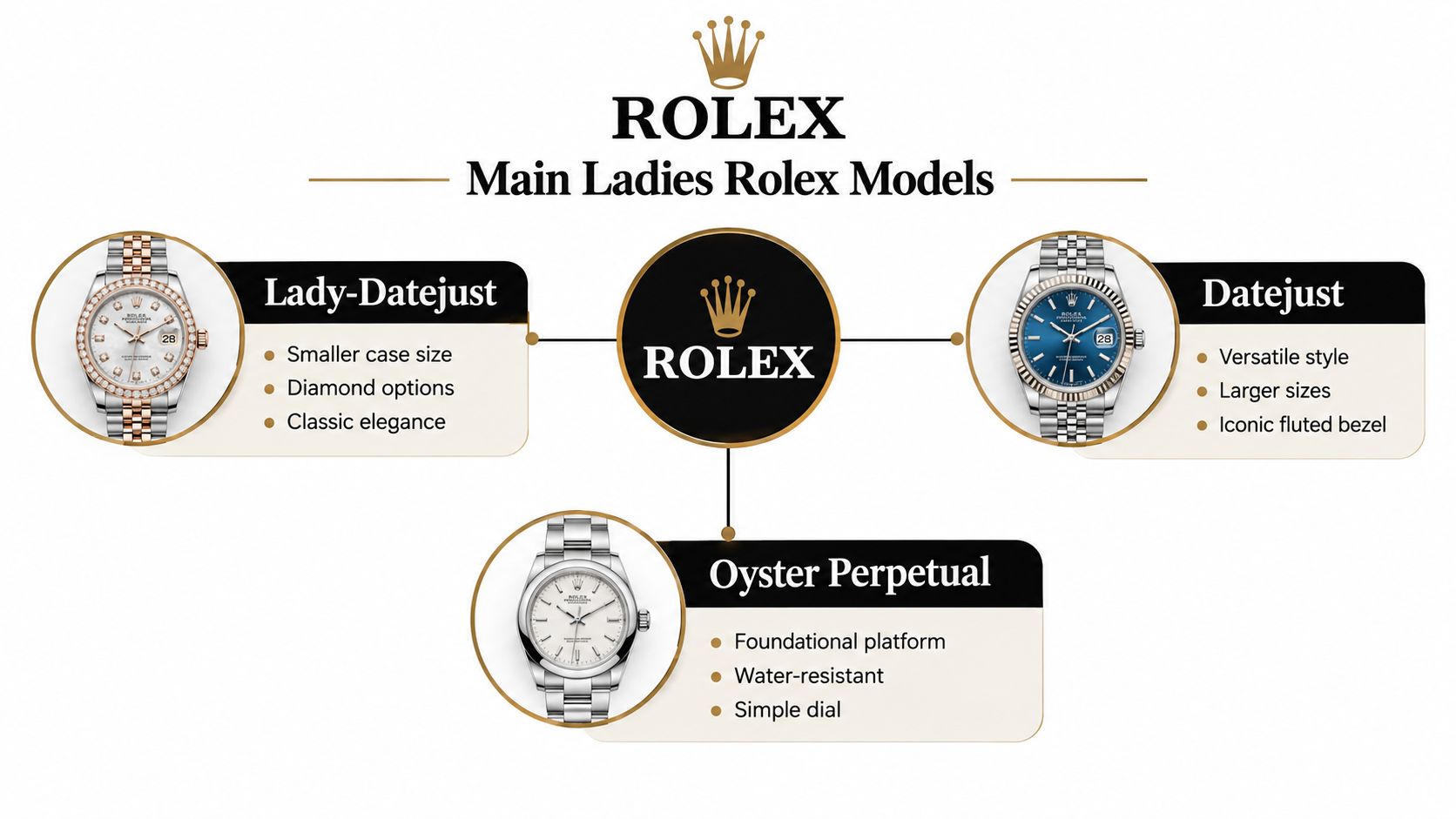
Understand the family before the reference
The Lady-Datejust combines the Datejust concept with smaller proportions. Rolex introduced the Datejust in 1945, followed by the Lady-Datejust in 1957 with a 25 mm case; the Lady-Datejust expanded to 28 mm in 2015, according to Rolex's Lady-Datejust history and features.
That history matters because watches sharing the Lady-Datejust name can belong to different design and movement generations. Age alone doesn't tell you whether an example is desirable, suitable, or ready for regular wear.
The Oyster Perpetual platform brings together automatic mechanical operation and a water-resistant case design. The Lady-Datejust adds the date display within that broader technical tradition. If you're considering the Oyster Perpetual family alongside date-equipped watches, our women's Oyster Perpetual overview offers another research path.
Build a useful listing description
A useful description should establish more than the model name.
- Identity: Record the reference number and stated production era.
- Dimensions: Confirm the case diameter and request measurements that explain how the watch wears.
- Configuration: Identify the metal, dial, bezel, and bracelet.
- Mechanics: Ask which calibre is fitted. A calibre is the particular movement inside the watch.
- Originality: Establish whether visible components are original, service replacements, or aftermarket additions.
Treat photographs as a starting point for those questions. A photograph may show the style you want without establishing the movement or the history of the dial.
For a family-level shortlist, compare the Rolex Datejust collection. Then evaluate each listing separately rather than assuming every watch within the collection offers the same features or condition.
Across-the-counter advice: If a seller can't identify the watch beyond “ladies Rolex,” ask for a more complete description before discussing payment.
Choose the Right Case Size and Wrist Fit
The smallest watch isn't automatically the right watch. We recommend choosing proportions you enjoy looking at and a dial you can read comfortably, not a category label.
Use wrist photographs to judge the relationship between the case, bracelet, and arm.
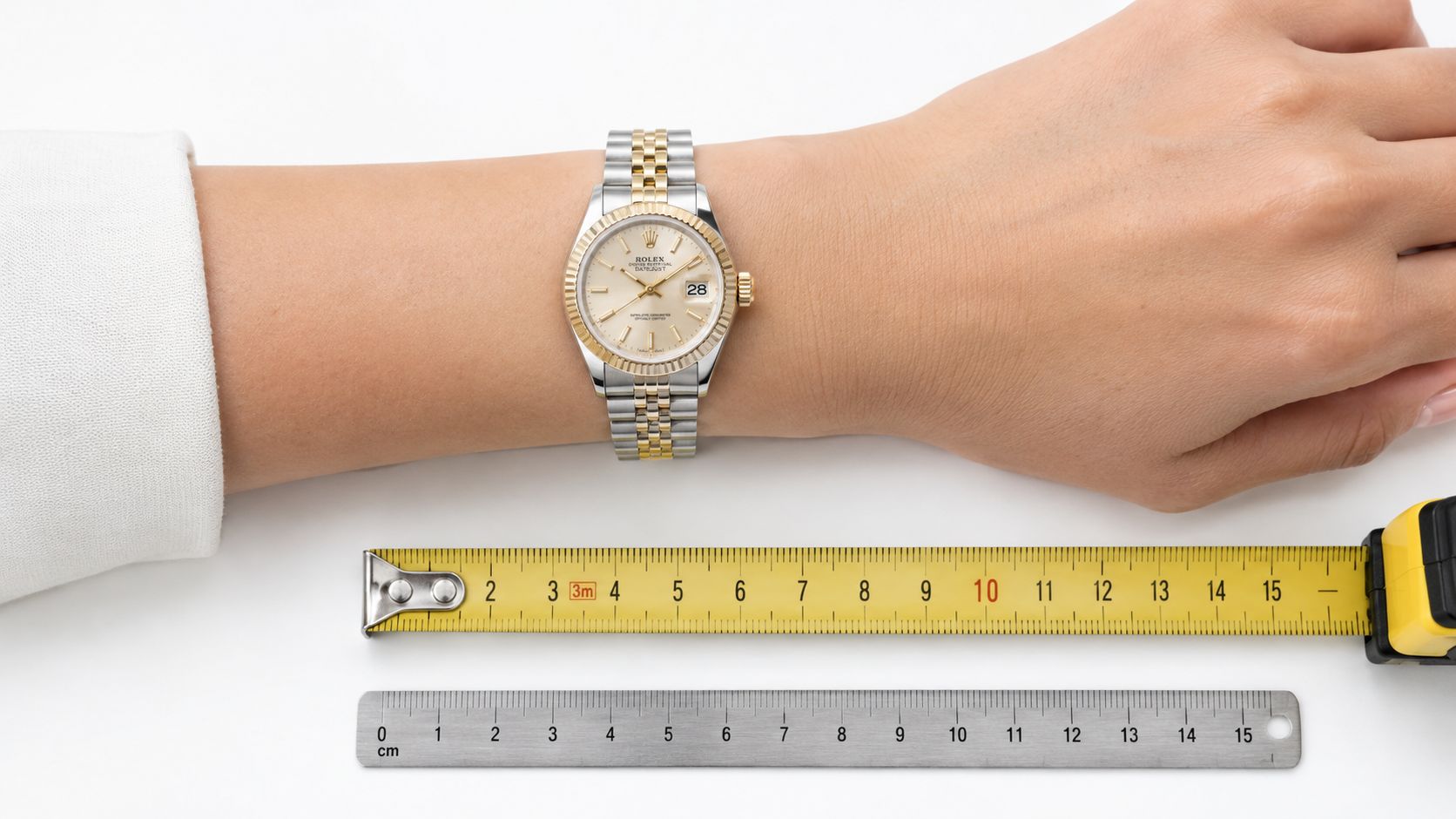
Measure more than your wrist
Measure your wrist where you wear a watch. Then ask for the watch's lug-to-lug measurement, meaning the distance between the outer ends of the case attachments, and the bracelet's usable circumference.
Don't compare case diameter in isolation. Ask how the bracelet sits, whether the clasp centers comfortably, and how much adjustment remains. A watch that looks balanced in a close-up photograph can still feel awkward when its bracelet can't be fitted properly.
Use these questions during a fitting or remote consultation:
- Readability: Can you read the hands without searching through the dial decoration?
- Movement: Does the watch slide excessively or press against your hand?
- Proportion: Do you prefer a discreet bracelet-like appearance or a more noticeable watch?
- Adjustment: Are enough links included, and can the bracelet accommodate your preferred fit?
Our Lady-Datejust size comparison can help you organize the options without imposing a rigid wrist-size rule.
The video below offers another visual reference while you assess proportion.
Consider who might wear it later
Smaller proportions can be exactly right for someone who wants a delicate-looking watch. A larger Datejust may suit someone who values a stronger visual presence or wants a watch that another family member could also enjoy.
Robb Report's coverage of smaller Rolex watches on the secondary market identifies activity around 31 mm and 36 mm Datejusts, with the latter attracting both women and men. That's useful market context, not a promise that your watch will sell quickly or retain a particular price.
Choose for your wrist first. Broader appeal is a secondary consideration, not a reason to buy a watch you won't wear.
Compare Lady-Datejust and Datejust References
Once you've chosen a general size, shift your attention to reference-specific questions. Similar-looking watches can have different movements, service histories, and replacement components.
Earlier 26 mm Lady-Datejust examples may use calibres 2030, 2135, or 2235, while current 28 mm models use calibre 2236, as described in Chrono24's Lady-Datejust model overview. That distinction should change the questions you ask about servicing and performance.
Pre-owned Rolex size and reference decision guide
| Case size | Likely buyer priority | Movement or service question | Ask the seller |
|---|---|---|---|
| Earlier smaller Lady-Datejust | Traditional proportions and period character | Which calibre is installed, and who last serviced it? | Which components have been replaced? |
| Current-generation Lady-Datejust | Compact proportions with modern mechanics | Does testing support the stated movement condition? | Can you provide the test results and service record? |
| Midsize Datejust | A balance of presence and wearability | What movement belongs to this exact reference? | Does the dial and bracelet configuration match the description? |
| Larger Datejust option | More visible dial and potential shared wear | What maintenance has this particular watch received? | What's included, and what work remains advisable? |
Judge the movement in context
Don't demand that an older movement meet a modern specification because both watches say Rolex on the dial. Equally, don't accept age as an excuse for unexplained poor performance.
Ask for a timegrapher report, which records aspects of a mechanical movement's running behavior. Useful information includes rate, amplitude, and beat error. Have the watchmaker interpret the results together rather than relying on a single attractive reading.
- For an older example: Prioritize identified movement condition, maintenance records, and an informed assessment of service needs.
- For a modern example: Ask whether measured performance supports the seller's description.
- For either: Get the scope of any seller warranty and return policy in writing.
Avoid assigning a movement solely from a case measurement or photograph. The seller should identify the reference and confirm the movement, not ask you to infer them.
Check Condition Authenticity and Water Resistance
A recognizable logo isn't an authentication method. Neither is a smooth-looking seconds hand, an attractive dial, or a box that appears correct.
A serious examination connects the watch's identity with its physical condition and operation. The checklist below is a prompt for questions, not a substitute for a watchmaker's inspection.
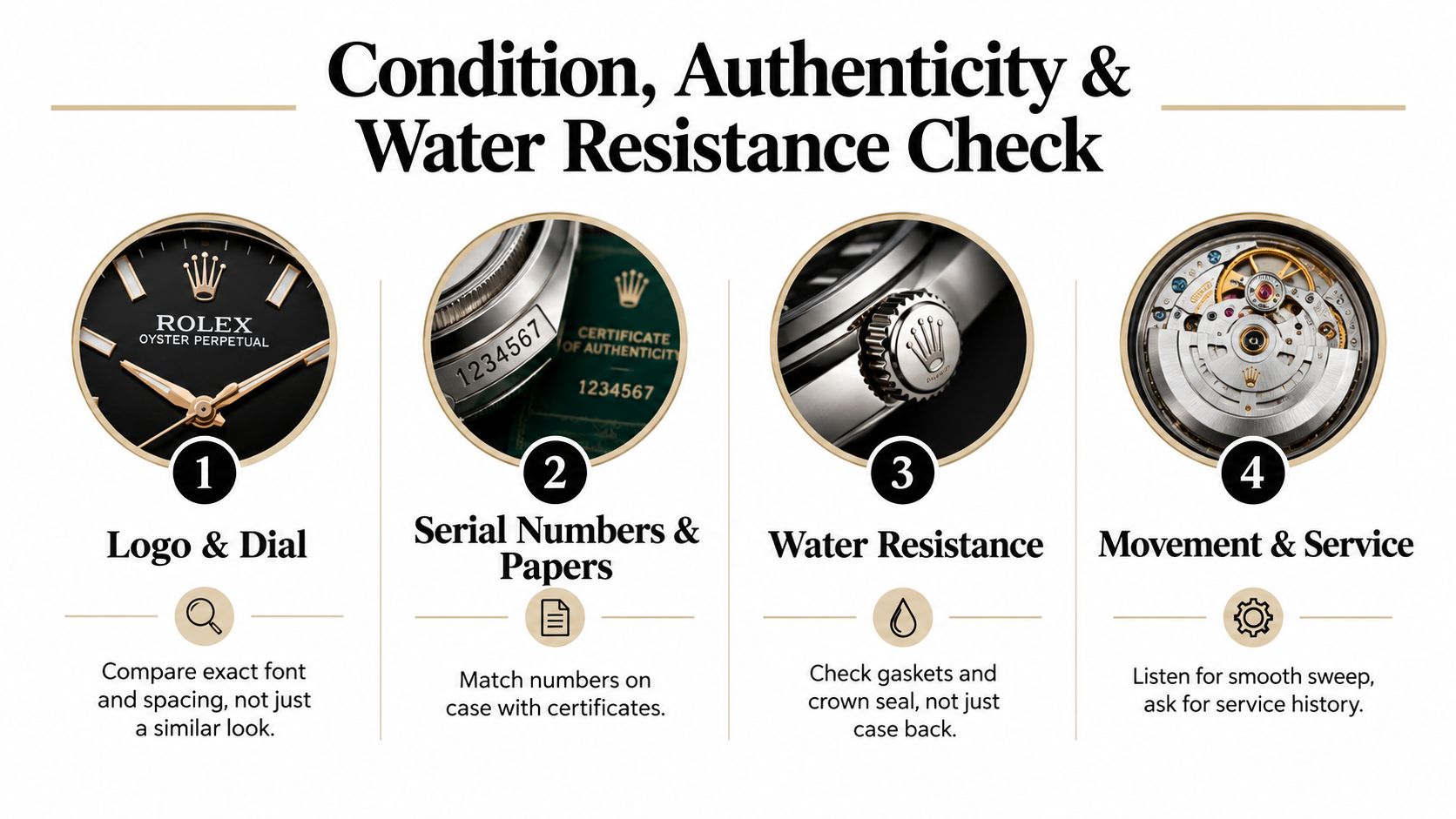
Ask what was physically examined
Chrono24's published inspection process provides a useful example of inspection scope: examination of the case, dial, hands, and movement; comparison of identifying details with papers; function and accuracy checks; and a lost-or-stolen database check. This describes that service's process, not a claim that every seller performs identical work.
Request a written condition description that distinguishes findings from assumptions.
- Case and polishing: Ask whether polishing is known or suspected and request clear photographs of edges, lugs, and surfaces.
- Bracelet: Examine wear, clasp operation, and link condition.
- Dial and hands: Ask about service replacements, refinishing, and any visible deterioration.
- Diamond configuration: Establish whether stones and settings are factory-original or later additions.
- Operation: Confirm date changeover, crown engagement, winding, and time-setting behavior.
A replacement component isn't automatically a reason to reject a watch. It is a reason to understand what changed, who performed the work, and whether the price reflects that configuration.
Our guide to evaluating whether a Rolex is real offers additional background. Don't attempt to settle a difficult authenticity question from photographs alone.
Treat water resistance as a test result
The current Lady-Datejust specification includes a screw-down case back, Twinlock crown, sapphire crystal, and water resistance to 100 metres/330 feet, as stated on Rolex's current Lady-Datejust specification page. That design rating doesn't establish the present condition of a pre-owned watch.
Seals age. Crowns can be damaged, and previous case opening can leave sealing problems if reassembly and testing weren't completed properly.
Ask for a recent pressure-test result and whether gaskets were replaced during service. Also request confirmation that the crystal and crown are intact and that no moisture is visible beneath the crystal or on the dial.
Until water-resistance testing is documented, treat the watch as a dry-use watch. A clean exterior doesn't prove healthy seals.
If the seller can't provide inspection evidence, make an independent examination part of the purchase decision. Agree on permission, timing, and the consequences of adverse findings before paying.
Evaluate Documentation Service History and Price
A full set is a description of accompanying items, not a diagnosis of the watch. Ask the seller to list exactly what's included rather than assuming the phrase covers everything you expect.
Purchase papers can support the watch's identity and history. A box is an accessory. Neither establishes current mechanical health, dial originality, polishing history, or successful water-resistance testing.
Separate records by what they establish
Our Rolex box and papers explanation can help you distinguish the package from the watch. For a buying decision, organize documents by purpose.
- Original purchase documents: Compare the identifying information with the physical watch.
- Service invoices: Read the work description, not just the date or total.
- Inspection reports: Look for findings about the actual watch being offered.
- Seller policies: Confirm what happens if a material problem appears after purchase.
A complete service performed by a Rolex Authorized Service Center returns a Rolex Service Card carrying an international two-year guarantee covering replacement parts and labor, according to Rolex's servicing procedure. That's a specific manufacturer service provision, not a blanket promise about a pre-owned purchase.
Ask who performed any other claimed service and what was done. “Recently serviced” shouldn't remain an undefined phrase.
Build a total-cost worksheet
Start with the current listing price in US dollars. Add only costs that apply and have been disclosed or quoted.
- Mechanical work: Include a written service estimate when work is recommended.
- Inspection and testing: Record any separate authentication or pressure-testing charge.
- Bracelet fit: Ask about the cost and availability of any required links.
- Transaction costs: Confirm applicable taxes and, for international purchases, relevant import obligations.
Don't invent a service allowance or apply a standard discount for missing papers. Obtain a watch-specific assessment.
Value test: We'd prefer an accurately described watch with honest wear and documented maintenance over an unworn-looking package with unanswered service questions.
Use prices from current listings when comparing our watches. Each pre-owned example can differ enough in condition and configuration that a model name alone won't support a fair price comparison.
Review Current ECI Ladies Rolex Options
Collection fallback, not verified individual inventory: We aren't presenting product cards or prices without confirmed live listing details. Use the Lady-Datejust collection as a starting point, then confirm the availability and description of any watch you select.
The website screenshot below is a visual reference, not confirmation that a particular watch remains available.
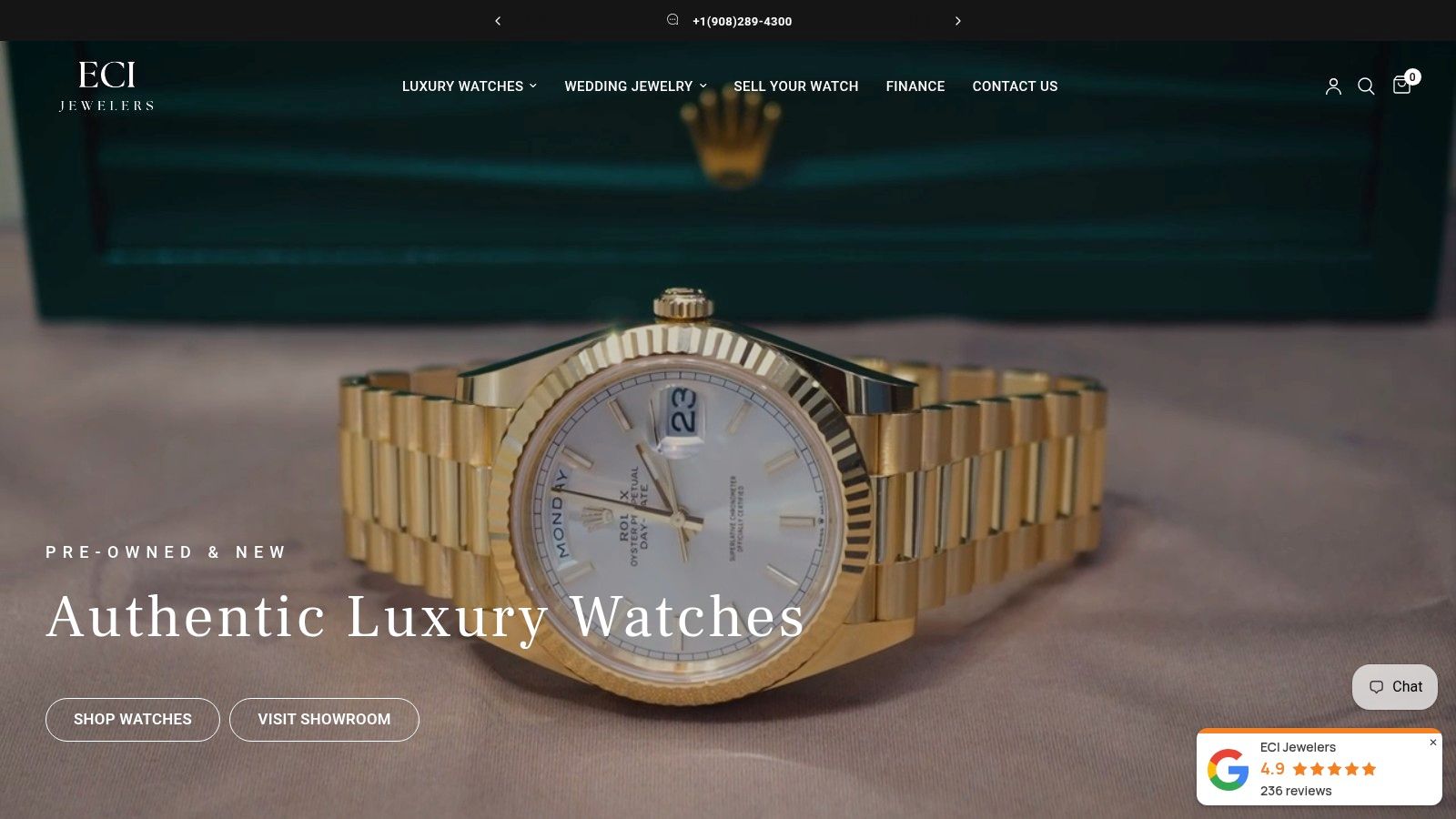
Turn browsing into a focused inquiry
Send the listing you're considering along with what matters most to you. “I want a discreet watch with a readable dial and documented maintenance” is more useful than “Which ladies Rolex should I buy?”
Include your preferred metal appearance, dial style, bracelet preference, and intended use. If it's a gift, describe what the recipient already wears instead of guessing from photographs.
- Request the exact description: Confirm reference, configuration, included accessories, and current asking price.
- Ask for missing evidence: Identify which photographs, measurements, or records you still need.
- Arrange a comparison: Ask which available watches would provide a meaningful alternative.
Don't rush because a pre-owned watch may be one of a kind. Scarcity doesn't answer a condition question. If the available example doesn't satisfy your requirements, keep the shortlist and wait for a better match rather than lowering your inspection standards.
How Can You Pay for a Pre-Owned Rolex
Choose the watch and understand its total cost before selecting a payment method. A manageable payment doesn't make an unsuitable watch a good purchase.
We offer financing through Affirm, Synchrony, Acima, and Snap Finance, with approval and terms set by each provider. Review our financing and leasing options, and compare the repayment obligation with your available budget.
Compare payment options separately
Our explanation of financing a Rolex watch provides another place to begin. Don't assume providers offer identical arrangements.
- Read the agreement: Check the total obligation, payment schedule, and applicable charges.
- Keep service in the budget: Don't commit every available dollar to the purchase if work remains outstanding.
- Consider a trade-in: Customers can trade in a luxury watch; ask for the assessment separately from the purchase discussion.
Frequently Asked Questions
What should I ask before traveling to see a watch?
Confirm that the specific watch is available for viewing and request the current description and asking price. Tell us which unresolved questions you need answered so the visit can focus on a decision rather than basic information gathering.
Are box and papers mandatory?
No, but missing documentation should change the depth of your due diligence. Decide whether the available inspection evidence and ownership history are sufficient before considering the accessories.
How should I interpret a service card?
Check that it relates to the watch being offered and verify the service date. Ask which accompanying documents explain the work, rather than treating the card as a complete condition report.
What if the watch was recently serviced or modified?
Request an itemized description of the work and disclosure of altered components. Then decide whether that configuration suits your priorities and whether any future service limitations need clarification.
ECI Jewelers offers pre-owned luxury watches online and in our New York City showroom, with personal guidance on narrowing your choices. Visit ECI Jewelers with your preferred style and budget, and ask us to help compare available ladies Rolex watches by fit, reference, condition, and documentation before you decide.


