

The reference number alone won't establish whether a Rolex 76080 is correctly described. Listings commonly identify it as a compact, time-only, self-winding stainless-steel Oyster Perpetual with a 24 mm case, but case measurements and movement details can vary between listings. Market records date examples from around 1998 into the mid-2000s, a guide rather than a confirmed factory production window.
Treat the paperwork and the watch as a set. Check that the movement, case, dial, bracelet and documentation are consistent with one another, then assess whether the condition supports the asking price. A 25 mm measurement or convincing-looking papers alone are not proof.
Rolex 76080 Specifications at a Glance
The Rolex 76080 is a compact steel Oyster Perpetual with automatic winding and no date display. It suits a buyer who wants a discreet watch rather than a large dial or extra functions.
Calibre means the movement's model name and design, not its quality grade. ATM means atmospheres of pressure, a unit used to describe a watch's water-resistance rating.
The specifications below are useful starting points, but published listings disagree on some details. In particular, a market-record date doesn't establish an exact factory production start or end date.
| Specification | Rolex 76080 detail |
|---|---|
| Reference | 76080 |
| Collection and display | Oyster Perpetual, time only, no date |
| Production years | About 1998 to 2006 as a market-record guide, not a confirmed factory production window. Chrono24's reference records identify examples dated 1999, 2000, 2001, 2002 and 2006, alongside an archival release estimate around 1998. |
| Case material | Stainless steel |
| Case diameter | 24 mm in most listings; some list 25 mm or 24 by 26 mm. Chrono24's UK reference catalog supports the 24 mm and approximately 24 by 26 mm descriptions, along with the water-resistance specification below. |
| Case thickness | About 9 to 10 mm; confirm the individual watch's measurement. |
| Movement | Automatic calibre 2230, with some examples documented as calibre 2130 in Collector Square's reference archive; inspect the movement rather than assuming the listing is correct. |
| Power reserve | About 42 or 48 hours in published listings; test the individual watch. |
| Water resistance | 10 ATM, about 100 m as a design rating, not a statement of present condition. |
| Crystal | Sapphire |
| Bezel | Smooth and fixed |
| Bracelet | Oyster |
| Dial colors | Black, blue, pink, silver and white |
The Oyster bracelet is the familiar broad-link steel bracelet, while the smooth bezel keeps the face visually simple. Neither feature settles originality: a correct-looking bracelet can be a replacement, and an attractive dial can have been refinished.
Practical rule: Buy a consistent watch, not a collection of individually plausible parts.
The reference number identifies the model family. It doesn't establish the condition, originality or service needs of the watch in front of you.
How a 24 mm Case Sits on the Wrist
Measure your wrist where you wear a watch, near the wrist bone. Wrap a flexible tailor's tape snugly around it without compressing the skin, then read the circumference in centimeters and inches.
Lug-to-lug is the distance from the tip of the upper lug to the tip of the lower lug, which helps determine whether the case extends beyond the top of your wrist. Diameter alone misses that dimension, the bracelet's first-link shape and the way your wrist curves.
Chrono24's reference listings describe the case as about 24 mm across and 9–10 mm thick, but the seller should measure the actual watch. Ask for the case width without the crown, plus a wrist photograph with a ruler visible; a close-up taken at an angle can make a small watch look much larger.
The following is a styling guide, not a sizing standard. Wrist shape and your preferred look matter more than a circumference category.
| Wrist circumference | Fit with a 24 mm case |
|---|---|
| Under 15 cm, about 5.9 in | Can have more presence on a very narrow wrist; don't assume it will look large. |
| 15 to 16.5 cm, about 5.9 to 6.5 in | A compact, balanced option if you prefer a traditional small watch. |
| 16.5 to 18 cm, about 6.5 to 7.1 in | Usually an understated, jewelry-like choice. |
| Over 18 cm, about 7.1 in | Looks small; consider the Lady-Datejust 26 or 28 if you want more presence. |
For example, the same case will appear more prominent on a six-inch wrist than on a seven-inch wrist. Removing bracelet links changes how securely it sits, not how large the dial looks.
Have a watchmaker size the bracelet with a correctly fitting screwdriver and proper support. Our watch case measurement guide explains the dimensions to request, and our Lady-Datejust size comparison helps if you prefer a larger alternative.
How to Confirm a Listing Is Really a 76080
A correct headline does not confirm the watch. Air-King descriptions, generic Oyster Perpetual specifications and copied seller text can all obscure the details that identify a Rolex 76080.
Use this visual checklist to organize the identity review.
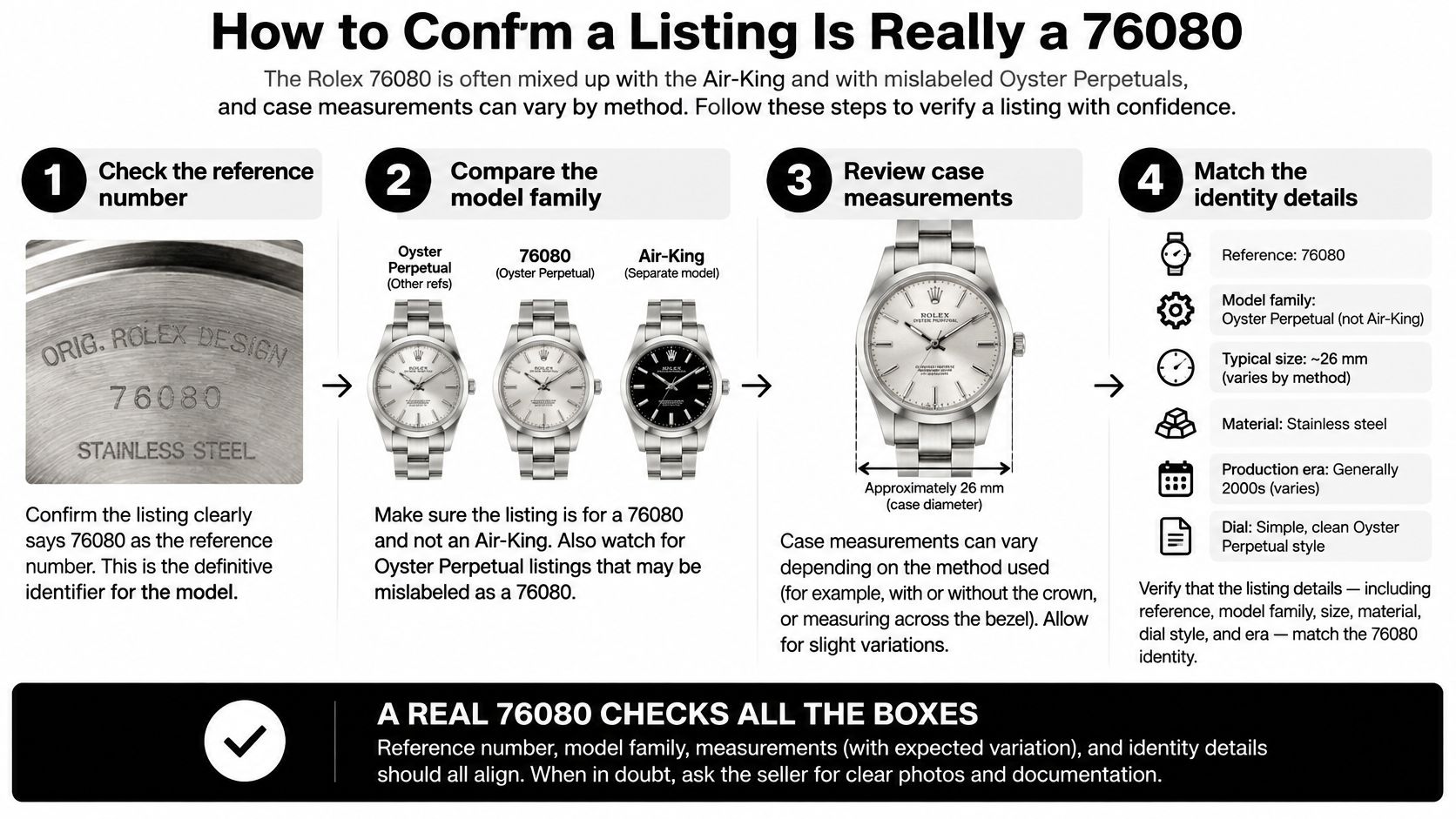
- Locate the actual case reference. Ask the seller or a watchmaker for a photograph of the reference engraving, typically accessed between the lugs after the bracelet is removed on watches of this period. Compare it with the paperwork. The clasp and exterior caseback may identify their own components rather than repeat the watch's reference.
- Identify the movement. Request a clear photograph taken after a professional removes the caseback, along with any service documentation. A typed specification is not proof of which movement is inside.
- Resolve the measurement method. BeckerTime's Oyster Perpetual history discusses conflicting 24–25 mm descriptions. A rounded measurement alone does not establish a different model or confirm authenticity.
- Check period consistency. Compare the serial, bracelet markings and documents with the claimed production period. An earlier watch should not be rejected for lacking a later-style engraved rehaut.
- Request a coherent photo set. Ask for images of the dial, caseback, between-lug engravings, clasp, end links and movement. Assess the details together, not as isolated clues.
- Arrange an independent inspection. Have a qualified watchmaker or Rolex service center assess unresolved questions before payment.
Our guide to checking whether a Rolex is real explains why isolated visual tests are not enough.
The video below provides additional viewing context, but it cannot authenticate a seller's watch.
Documentation and component consistency matter more than one measurement. Check that the movement, dial, bracelet and engravings make sense together. A seller should be able to explain any replacement part, and an asking price is not proof of value.
What to Check When Assessing Condition
Condition can change what we'd pay more than the shared reference number does. Start with the parts that are expensive to correct or impossible to return to their original state.
| Check | What to look for | Red flag |
|---|---|---|
| Crystal | Clear sapphire with light wear | Chips or an undisclosed replacement |
| Case | Crisp edges and preserved shape | Softened lugs or heavy polishing |
| Bracelet | Limited looseness and a working clasp | Excessive stretch or mismatched end links |
| Crown and seals | Crown screws down cleanly | Loose crown or no current pressure-test evidence |
| Dial | Correct printing and consistent finish | Undisclosed refinishing or replacement |
| Movement | Steady running and tested power reserve | Unsupported reserve claim or unstable timing |
| Caseback and rehaut | Period-appropriate features and identifiers consistent with documents | Mismatched markings, or an expected engraving absent without explanation |
Cosmetic wear versus altered components
Surface scratches are usually easier to accept than heavily reduced lugs. Polishing removes metal, so a bright finish isn't automatically better than a scratched case with well-preserved proportions.
Our polished versus unpolished Rolex guide explains that trade-off. A disclosed factory service dial can be suitable for daily wear, but it shouldn't be valued as an untouched original dial.
Mechanical claims need test results
Power reserve is how long the watch runs after it's fully wound. A Watches of Switzerland listing reports approximately 48 hours, while other market descriptions give approximately 42 hours; neither figure tells you what an untested example achieves.
Ask for timing results in different positions and an actual running-duration test. A movement can run when photographed yet still need attention to winding, lubrication or regulation.
A watch that ticks isn't necessarily a watch that's ready for daily use.
A pressure test checks water resistance under controlled pressure, commonly using dry air-testing equipment. Ask for a written condition report, the test result and any available service history; a cleanly seated crown alone doesn't establish that the seals are sound.
What a Pre-Owned 76080 Typically Sells For
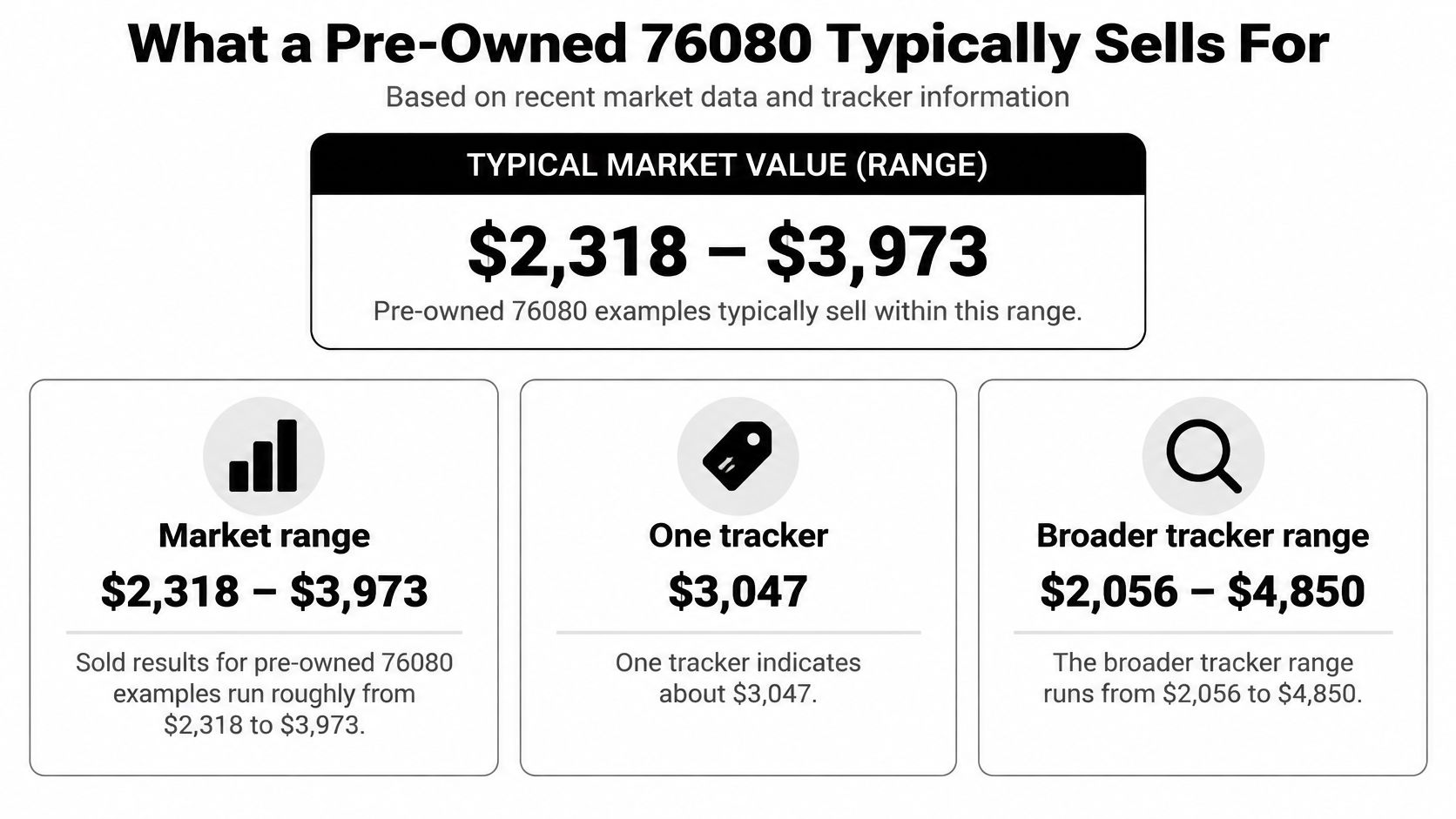
EveryWatch's reference records show mixed sold results and listings around $2,318 to $3,973. The range is useful for comparison, but it is not a sold-only valuation. EveryWatch's Rolex 76080 records show the figures and their scope.
| Source | Figure | What it measures |
|---|---|---|
| EveryWatch records | About $2,318 to $3,973 | Mixed sold results and listings, not a uniform sold-only sample |
Other market listings vary widely. Use the range as a starting point, not a target: an asking price does not prove what a watch sold for, and a reference number alone cannot establish value. Why two Rolex watches with the same reference can have different prices
Build a defensible comparison
- Start with sold examples. Compare watches with the same movement configuration and a similar production period.
- Check whether the dial is original, service-replaced or refinished.
- Compare bracelet completeness, usable length and stretch.
- Adjust for heavy polishing, aftermarket components and unresolved service needs.
- Count box and papers as part of the comparison only when they belong with the watch.
- Compare the final cost, including the seller's written warranty and return terms.
A well-kept example may attract buyers looking for a compact Rolex, but resale is never guaranteed. Judge the specific watch and its documentation rather than assuming that an asking price reflects its value.
What to Ask a Seller Before You Pay
Get the seller's answers in writing while you can still decide not to proceed. A clear invoice and condition description are more useful than a reassuring phone conversation.
- Included accessories: Does the price include a box, original sales papers, service documents and the full available bracelet?
- Accessory identity: Which documents are original to this watch, and which are later service records or replacement packaging?
- Watch specification: Will you confirm the case reference, inspected movement calibre and measured case diameter in writing?
- Replacement parts: Will you list any known replacement crystal, dial, hands, crown or bracelet?
- Service history: Can you provide dated records naming the workshop and describing the work?
- Water resistance: When was the latest pressure test, and can you provide its result?
- Return rights: What is the written return window?
- Inspection rights: Can an independent watchmaker inspect the watch without affecting those rights?
- Warranty: What does the written warranty cover and exclude?
Papers can be reproduced or forged, and later service documentation isn't the same thing as original sales paperwork. Our Rolex box and papers guide explains how to distinguish the documents.
We sell pre-owned watches and aren't an authorized Rolex dealer. We don't describe these watches as Rolex Certified Pre-Owned.
Before payment: If an answer affects your decision, have it written into the transaction documents.
Each pre-owned watch is one of a kind. A careful answer matters more than a fast purchase.
How can you pay for it?
We offer financing through Affirm, Synchrony, Acima and Snap Finance, with approval and terms set by each provider. Review our financing and leasing options, then read the relevant provider's terms before applying. Your monthly cost depends on the provider, approval and agreement, so compare the total payable rather than choosing by the monthly figure alone.
You can also trade in a luxury watch. Keep the purchase decision and trade-in valuation separate so you understand both amounts. The watch you're buying should still meet your condition and fit requirements, regardless of how you pay.
Frequently asked questions
Can you swim with a Rolex 76080?
A pre-owned watch's water-resistance rating does not confirm its current condition. Have the 76080 pressure-tested, particularly after case work, and make sure the crown is fully screwed down before water exposure. Avoid hot water. After any saltwater exposure, rinse the watch with fresh water, dry it thoroughly, and have a watchmaker check the seals before wearing it in water again.
Who should service a 76080 and how often?
Choose a Rolex service center or a qualified watchmaker familiar with the installed movement. Ask for the service record before buying. A service check should cover timing, automatic winding and power reserve; base future service on the watch's condition, performance and professional advice rather than a fixed interval.
Is a 76080 a good first Rolex?
It can suit a buyer who wants a compact steel watch with a time-only dial and no date. Compare wrist fit, readability and the condition of the individual watch before deciding. Its reference number alone does not establish that its movement, dial, bracelet and engravings are consistent, and an asking price is not proof of value.
ECI Jewelers offers pre-owned Rolex Oyster Perpetual and Lady-Datejust models for buyers comparing compact watches. Visit ECI Jewelers to discuss size, dial and documentation, or browse the Lady-Datejust 26 collection as a slightly larger alternative. Confirm the specific watch's details before you buy.


