

A ladies Rolex with diamonds is usually a Lady-Datejust or Datejust with diamonds on the bezel, dial, hour markers, case or bracelet, and the right one depends on case size, where the stones sit, and whether that setting matches the watch's original Rolex configuration. At ECI, diamond-dial Lady-Datejust 26 models start at $6,900, and factory diamond bezel pieces run from $23,500 for a Datejust 36 116243 to $24,900 for a Lady-Datejust 28 279381RBR (October 2026).
You're comparing photos of two watches with similar sparkle, but one may have a small diamond bezel while the other has stones across its dial or bracelet. The Lady-Datejust began as a watch designed for women, and today buyers can compare petite cases with larger Datejust options. We'll look at how those sizes wear, how factory-set diamonds differ from later additions, and what to check before buying a pre-owned example. Then you can use those details to decide which styles to explore with ECI Jewelers.
In this article
- What is a ladies Rolex with diamonds?
- Why did the Lady-Datejust start this category?
- Which case size fits your wrist?
- How do factory diamonds differ from later work?
- How much is a ladies Rolex with diamonds in 2026?
- How do you judge the diamonds on a pre-owned Rolex?
- Which diamond Datejust styles should you consider?
- How can you pay and take the next step?
- Frequently asked questions
What Is a Ladies Rolex with Diamonds?
Two watches can look equally bright in a listing photo and be quite different in person. One may have diamonds only on the hour markers. Another may have a gem-set bezel, a diamond-paved dial, or stones across the bracelet. The phrase ladies Rolex with diamonds covers all of these, so it helps to identify the exact parts carrying the stones before comparing examples.
The watch underneath is still a Rolex watch, not jewelry built around a watch face. A Datejust or Lady-Datejust has a mechanical movement and a date display. The diamond setting changes the appearance and can affect the watch's configuration, but it doesn't tell you by itself how the watch fits your wrist or whether the stones were set by Rolex.
Start with the reference, not the listing title
A seller's title might say "diamond Rolex," but that wording leaves out important details. Check the case size in millimeters, the metal, the bracelet, and where the diamonds sit. On a two-tone model, the term Rolesor means Rolex combines Oystersteel with gold.
That distinction matters because similar-looking watches can have different original configurations. A diamond bezel may be part of a specific Rolex reference, or it may have been added after the watch left the factory. In a pre-owned listing, compare the reference number and visible details with Rolex documentation rather than relying on photographs and the title alone. Our Rolex serial number lookup helps you check the production period too.
At the counter, we start with three questions: What size is the case, which parts have diamonds, and do those details match the reference?
A smaller case doesn't automatically mean fewer stones. A compact Lady-Datejust can carry diamonds across several parts, while a larger Datejust can have a restrained diamond accent. The amount of diamond work and the watch's size are separate decisions.
If you're shopping for a watch you'll wear regularly, consider how the dial reads, how the bracelet feels, and whether the diamond setting suits the occasions when you'll wear it. If you're buying a pre-owned piece, ask for documentation and service records. Those details help you judge the whole watch, not just the sparkle.
Why Did the Lady-Datejust Start This Category?
Rolex introduced the Lady-Datejust in 1957 as the women's counterpart to the Datejust, which had debuted in 1945. The Lady-Datejust kept the Datejust's date display, Oyster case, and Perpetual automatic winding in a smaller watch. It wasn't a men's watch made smaller after the fact. Rolex designed it as a women's model with the same focus on mechanical timekeeping.

A defining part of the design was its chronometer certification. COSC is an independent organization that tests watch movements for precision. Rolex states that the Lady-Datejust achieved COSC certification, showing that a compact women's watch could meet the same precision standard associated with larger professional timepieces (Rolex's history of the Lady-Datejust).
A women's watch with mechanical credentials
The model also reflected the lives of women taking on more active and independent roles during the postwar period. Its purpose was to give women a smaller automatic watch with the useful date display and technical features of the Datejust, not to turn a watch into an ornament.
Over time, Rolex used the Lady-Datejust as a platform for precious metals and gem-set designs. Diamonds appeared on bezels and dials, and, in some configurations, on cases and bracelets. That history helps explain why a diamond-set Lady-Datejust can be both a functional watch and a piece of jewelry.
The line is now nearly seven decades old, so pre-owned examples span different generations and configurations. A diamond bezel alone doesn't tell you which model you're looking at, or whether the rest of the watch is original to its reference. Case size and the exact placement of the stones matter just as much as the family name. For a closer look at the smaller historic models, see our guide to the Rolex Lady-Datejust 26, or browse the Lady-Datejust 26 collection.
Which Case Size Fits Your Wrist?
Case diameter changes how a watch sits on the wrist, yet it tells you nothing about how many diamonds it carries. A 28 mm Lady-Datejust can come heavily gem-set, while a 36 mm Datejust may have stones only on its bezel. Pick the size that suits your wrist and daily comfort first. Then compare where the stones sit.
Rolex describes the current Lady-Datejust as a 28 mm watch and its smallest model with a date window (Rolex Lady-Datejust specifications). Beyond that, pre-owned shoppers weigh older 26 mm examples against larger Datejust models around 31 mm and 36 mm. The small cases wear more like jewelry. A larger case gives the dial more room, which makes the date easier to read at a glance.
Diamond Datejust size at a glance
| Case size | Best suited to | Date and dial | Resale note |
|---|---|---|---|
| 26 mm | A smaller wrist or a traditional petite look | Compact dial, with less room for details | A classic proportion; compare condition and configuration carefully |
| 28 mm | A discreet everyday watch with a jewelry-like presence | A little more dial room while remaining petite | The current Lady-Datejust size; originality still matters |
| 31 mm | Someone who wants a middle ground in wrist presence | More space for reading the date and seeing the dial | A practical size to compare with 28 mm examples |
| 36 mm | Someone who prefers a larger, more visible watch | Larger dial that's easier to scan at a glance | Can appeal to buyers who prefer a more versatile case size |
Size also shapes who buys the watch later. Pre-owned shoppers increasingly look past the petite tradition and try on larger cases, so a 31 mm or 36 mm Datejust often draws a wider pool of buyers when it comes time to resell. Smaller models still hold their own for anyone who wants discreet proportions and a stronger jewelry feel. Neither is wrong. It comes down to how you plan to wear it.
For a side-by-side look at the petite end, our Lady-Datejust 26 vs. 28 vs. 31 size guide walks through each case on the wrist.
One last detail worth checking on any pre-owned listing. Features like the Cyclops lens over the date, the screw-down crown, and the screw-down case back should match the stated reference. They help confirm you're looking at the right model, though they say nothing about whether the diamond work is original.
How Do Factory Diamonds Differ from Later Work?
A diamond bezel can look polished in a photo whether Rolex set it at the factory or someone added it later. The difference is provenance. A factory-set bezel, diamond dial, or gem-set bracelet belongs to a specific Rolex configuration and should agree with the reference number, metal, and manufacturer's description.

Later-added stones can still be attractive, but the change may affect the watch's documented history, serviceability, insurance review, and resale confidence. That's why more diamonds don't automatically make a better purchase. A less elaborate watch with a verifiable original configuration can be a stronger choice than one with more stones and unclear history.
What to check before you buy
Compare the reference number with Rolex's technical description. Then look at the case metal, diamond layout, dial, bracelet, and clasp. Ask for service records, and consider an independent appraisal that separates the watch itself, the precious metal, and the condition of the diamond setting.
The difference in scale can be substantial. A bezel-only model may use dozens of stones, while an extensively gem-set gold Lady-Datejust can carry diamonds across the bezel, dial, and bracelet. For example, Rolex's specification for the 18 ct yellow gold Lady-Datejust reference 279458RBR lists a diamond-set bezel, paved dial, bracelet, case sides, and lugs (Rolex's reference 279458RBR specifications). That's a very different configuration from a watch with only diamond markers.
Tracked asking prices offer context, not an ECI Jewelers quote. One market analysis places pre-owned two-tone 31 mm models at about $7,000 to $12,000, with factory diamond markers or a fluted bezel toward the upper end. The same analysis identifies a Datejust 36 with a factory diamond bezel at approximately $16,000 in its tracked secondary-market set (tracked market analysis of women's Rolex watches).
Watches tend to hold value better when their configuration is original and documented, but no price history predicts what a specific watch will sell for. For a closer look at what a diamond bezel changes, see our article on diamond bezels on watches.
How Much Is a Ladies Rolex with Diamonds in 2026?
Diamond dials are far more common than factory diamond bezels, and that shows in price. These are ECI asking prices for diamond-set Lady-Datejust and Datejust watches in stock in October 2026:
| Size | Metal and diamonds (references) | ECI price range |
|---|---|---|
| 26 mm | Yellow Rolesor, diamond dial (69173, 179173) | $6,900 to $9,800 |
| 26 mm | White Rolesor, diamond dial (179174) | $8,500 |
| 26 mm | Everose Rolesor, diamond dial (179171) | $11,300 to $11,500 |
| 26 mm | 18k gold President, diamond dial (69178, 179178, 179179) | $12,900 to $21,000 |
| 28 mm | Rolesor, diamond dial (279173, 279171) | $15,500 to $17,400 |
| 28 mm | Everose Rolesor, factory diamond bezel and dial (279381RBR) | $24,900 |
| 31 mm | Rolesor, diamond dial (68273, 178271, 278273) | $9,750 to $16,500 |
| 31 mm | 18k gold, diamond dial (68278, 178245, 278278) | $19,500 to $43,500 |
| 36 mm | Rolesor, diamond dial (16233, 116231, 116233, 126233, 126234) | $8,200 to $17,900 |
| 36 mm | Rolesor, factory diamond bezel (116243, 126281RBR) | $23,500 to $29,500 |
Prices change as watches sell. The two-tone 69173 with a factory diamond dial is the most accessible way into a diamond Lady-Datejust; a factory diamond bezel roughly doubles the starting price. For more on gold and gem-set pieces, see our ladies' Rolex price and buying guide.
How Do You Judge the Diamonds on a Pre-Owned Rolex?
Mechanical condition and diamond condition are separate questions. A correct movement calibre doesn't tell you whether a small pavé stone is chipped, loose, or poorly matched. Inspect the setting as carefully as you inspect the watch, and ask what documentation supports the claim that the diamonds are factory-set.

Look at the stones under magnification
The Gemological Institute of America grades diamond color on a D-to-Z scale. Its clarity assessment looks at inclusions and blemishes under 10× magnification, including their number, size, relief, and position. For round brilliant diamonds, the cut assessment considers proportions, facet angles, polish, and symmetry (GIA's diamond buying guide). Our diamond clarity and color guide explains those grades in plain terms.
For a diamond-set Datejust or Lady-Datejust, start with the basics. Are the stones similar in size and color? Does the spacing look even? Under magnification, look for chips, abrasion, loose settings, or gaps that might indicate a missing stone.
Pavé uses many small stones, so even one loose or missing diamond can call for a specialist setter, not just a watchmaker. Some Rolex diamond dials use diamonds mounted in 18 ct gold settings. That's one reason to document exactly which parts are gem-set instead of relying on a broad description.
Keep the records specific
Write down whether the bezel, dial, markers, case, or bracelet carries stones. Ask for the service history and for paperwork that supports the stated configuration. An independent appraisal can separate the watch's value from the precious-metal value and the current condition of the setting.
A correct movement and a polished exterior aren't enough to establish the quality or origin of the diamonds. For additional context on documentation and pre-owned Rolex terminology, see our explanation of certified pre-owned Rolex, and our 12 checks to tell if a Rolex is real. The label in an article title doesn't replace checking the actual reference and records.
Good enough to buy means the configuration is documented, the stones look even, and the settings are secure. If the seller can't explain where the diamonds are or whether they match the reference, keep asking before you commit.
Which Diamond Datejust Styles Should You Consider?
Once you know your preferred size and have checked the watch's originality, compare styles by how you'll wear them. A diamond bezel, diamond markers, a paved dial, and a gem-set bracelet create different levels of visual presence. Start with the case and metal, then decide which diamond details you want to see every day.
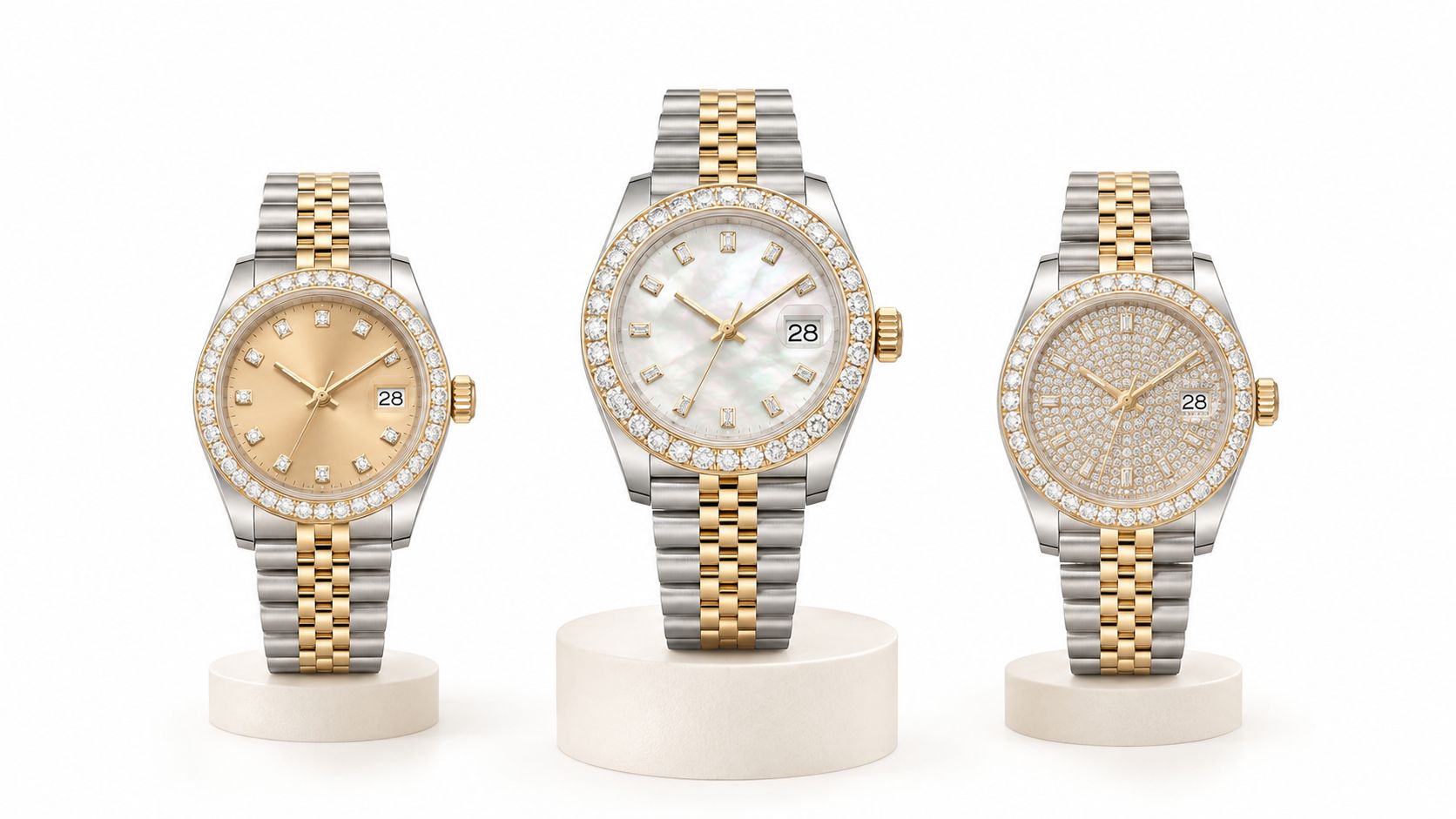
Three paths to compare
A Lady-Datejust with a diamond bezel suits someone who wants a smaller watch with a noticeable jewelry detail. Check the case size, metal, and whether the dial or markers are also set with diamonds. On a two-tone example, confirm which sections are Oystersteel and which are gold. See the current Lady-Datejust 28 collection.

28 mm · Everose Rolesor · 2025
Rolex 279381RBR Lady-Datejust 28, Aubergine Diamond Dial
Factory diamond bezel, Jubilee bracelet, box and papers.
$24,900 View the watch →
A Datejust 31 can suit someone who wants more dial presence without moving to the larger case. It gives you a useful middle option between a petite Lady-Datejust and a 36 mm Datejust. Look closely at the bezel and dial: two watches of the same size can have very different diamond layouts. Compare examples in our Datejust 31 collection.

31 mm · Yellow Rolesor · 1993
Rolex 68273 Datejust 31, Silver Jubilee Diamond Dial
18k yellow gold fluted bezel, Jubilee bracelet, box and papers.
$9,750 View the watch →
A 36 mm Datejust with a factory diamond bezel may be a practical choice for someone who wants a larger, more visible dial and everyday flexibility. A tracked market analysis has identified this configuration as a liquid option within its set, but that doesn't guarantee demand or resale for a particular piece. Condition, documentation, metal, and configuration still shape the comparison. Browse the Datejust 36 collection.

36 mm · Yellow Rolesor · 2017
Rolex 116243 Datejust 36, MOP Diamond Dial
Factory Rolex diamond bezel, mother-of-pearl diamond dial, box and papers.
$23,500 View the watch →
When choosing among these styles, note whether the watch is Oystersteel, yellow, Everose, or white Rolesor, or 18 ct gold. Then identify whether the stones are on the bezel, hour markers, dial, case, or bracelet. Match those details to the reference rather than assuming that the word "diamond" tells the full story.
Rolex's Lady-Datejust calibre 2236 is a self-winding mechanical movement with an accuracy target of -2/+2 seconds per day after casing and an approximately 55-hour power reserve. It provides central hours, minutes, and seconds, plus an instantaneous date with rapid setting and stop-seconds; the relevant specification also lists 100 metres of water resistance (Rolex calibre 2236 technical brochure). Ask about service history as well as the condition of the stones.
ECI Jewelers offers pre-owned Rolex watches, including Lady-Datejust models. The available inventory can change, and each pre-owned watch is one of a kind, so compare the exact listing and reference rather than assuming a pictured style is currently available. Browse the Lady-Datejust collection and Datejust collection to see what's listed. If you're shopping as a couple, our guide to matching his-and-hers Rolex watches can help you compare styles, while the ladies' Rolex price and buying guide offers another starting point.
How Can You Pay and Take the Next Step?
ECI Jewelers offers financing through Affirm, Synchrony, Acima, and Snap Finance, with approval and terms set by each provider. Review the flexible financing and leasing options before deciding how you'd like to pay. Customers can also ask about trading in a luxury watch through ECI's luxury watch trade-in service.
Center your decision on the fit, the reference-matched diamond setting, and the watch's condition. A dense diamond display may catch your eye, but it isn't a substitute for original configuration and clear documentation.
Frequently Asked Questions
How much is a ladies Rolex with diamonds?
At ECI in October 2026, a Lady-Datejust 26 with a diamond dial starts at $6,900 for a two-tone 69173, and solid gold President models run $12,900 to $21,000. Watches with a factory diamond bezel start at $23,500 for a Datejust 36 116243 and $24,900 for a Lady-Datejust 28 279381RBR.
How can I tell if the diamonds on a Rolex are factory set?
Compare the reference number with Rolex's description of that model: a factory diamond bezel or dial should match the reference, metal and documentation. Ask for papers and service records that list the configuration, and check that stones are even in size, color and spacing.
Do aftermarket diamonds lower a Rolex's value?
They usually reduce resale confidence because the watch no longer matches its original Rolex configuration, and they can complicate servicing and insurance. A watch with fewer stones and a documented original setting is often the stronger buy.
Which size ladies Rolex with diamonds should I choose?
Choose the size first: 26 or 28 mm for a petite, jewelry-like look, 31 mm for a middle ground, or 36 mm for a larger, easier-to-read dial. Then decide where you want the diamonds. Size and the amount of diamond work are separate decisions.
Find Your Diamond Datejust
Choose the case size that sits right on your wrist, then confirm the diamond setting matches the reference. Factory-set stones carry a clearer originality story than later work.
Shop Women's Watches →Or browse the Lady-Datejust 26, Lady-Datejust 28 and Datejust 31 collections.
Compare pre-owned Lady-Datejust and Datejust watches with ECI Jewelers in New York or online. Browse the pre-owned Rolex selection at ECI Jewelers and ask about the specific watch you have in mind. Prices shown are as of October 2026. Each piece is one of a kind.


