


If you're shopping for a Lady-Datejust blue dial, start with case size, then metal and bezel, then the exact reference. For most buyers that means a 28 mm in Oystersteel or Rolesor; the 26 mm is the classic, lower-cost pre-owned choice, and 31 mm suits larger wrists. At ECI, a blue dial Lady-Datejust 26 starts at $7,900 and a blue dial Datejust 31 at $9,500 (October 2026). You're probably looking at photos that all seem similar, a small blue face, a date window, a Jubilee bracelet, while prices and sizes jump around. We see that confusion at the counter every week. The blue dial isn't one watch. It's a dial color fitted to different generations, sizes, and metals, and that distinction decides fit, movement, and what you should check before you pay.
In this article
- What is a Lady-Datejust blue dial watch?
- Should you choose 26 mm, 28 mm, or 31 mm?
- Which metal and bezel suit a blue dial?
- How much does a Lady-Datejust cost in 2026?
- What movement is inside, and what does it mean for daily wear?
- Which blue dial Lady-Datejust should you look at?
- What should you check before buying a pre-owned blue dial?
- Frequently asked questions
What Is a Lady-Datejust Blue Dial Watch?
You're likely choosing between a gift purchase and a watch you'll wear daily, and you want blue because it reads clean with steel and gold. That's a sound starting point. Don't stop at color.
The Lady-Datejust is a platform, not a single reference. Rolex introduced it in 1957 as the women's counterpart to the Datejust, and the original model measured 25 mm, much smaller than the 36 mm Datejust tied to the line's 1945 launch, as Rolex outlines in its Lady-Datejust history and features. Rolex later moved the case to 28 mm in 2015. Between those points, the long-running 26 mm generation became the classic pre-owned size you'll still find often.
That history matters when you're comparing listings. A 26 mm blue dial and a 28 mm blue dial can look alike in a photo, but they belong to different generations, with different movements and wrist presence. Ask for the reference number first. Dial color alone won't tell you the production era.
What stays the same across generations
Two features define the model across sizes. You get the date aperture at 3 o'clock and the Cyclops magnifying lens over it. Those details connect a modern blue dial to the original Datejust design, a lineage we also cover in our history of the Rolex Datejust as a classic watch.
Blue also works across metals. Depending on reference, you'll see it in Oystersteel, Rolesor, and 18 ct gold, with smooth, fluted, or gem-set bezels. Rolesor means Rolex combines Oystersteel with gold in the same watch.
Buy the reference and configuration first, and treat blue as the finishing choice within that setup.
Our recommendation is simple. Decide size for your wrist, metal for your wardrobe and budget, and bezel for how dressy you want it to look. Then verify originality and service history. If you reverse that order and chase a pretty blue photo, you'll overpay for the wrong generation or miss an aftermarket dial.
Should You Choose 26 mm, 28 mm, or 31 mm?
Here's a practical way to picture the three sizes you'll meet most often. For a deeper side-by-side, see our full Lady-Datejust 26 vs 28 vs 31 size guide.
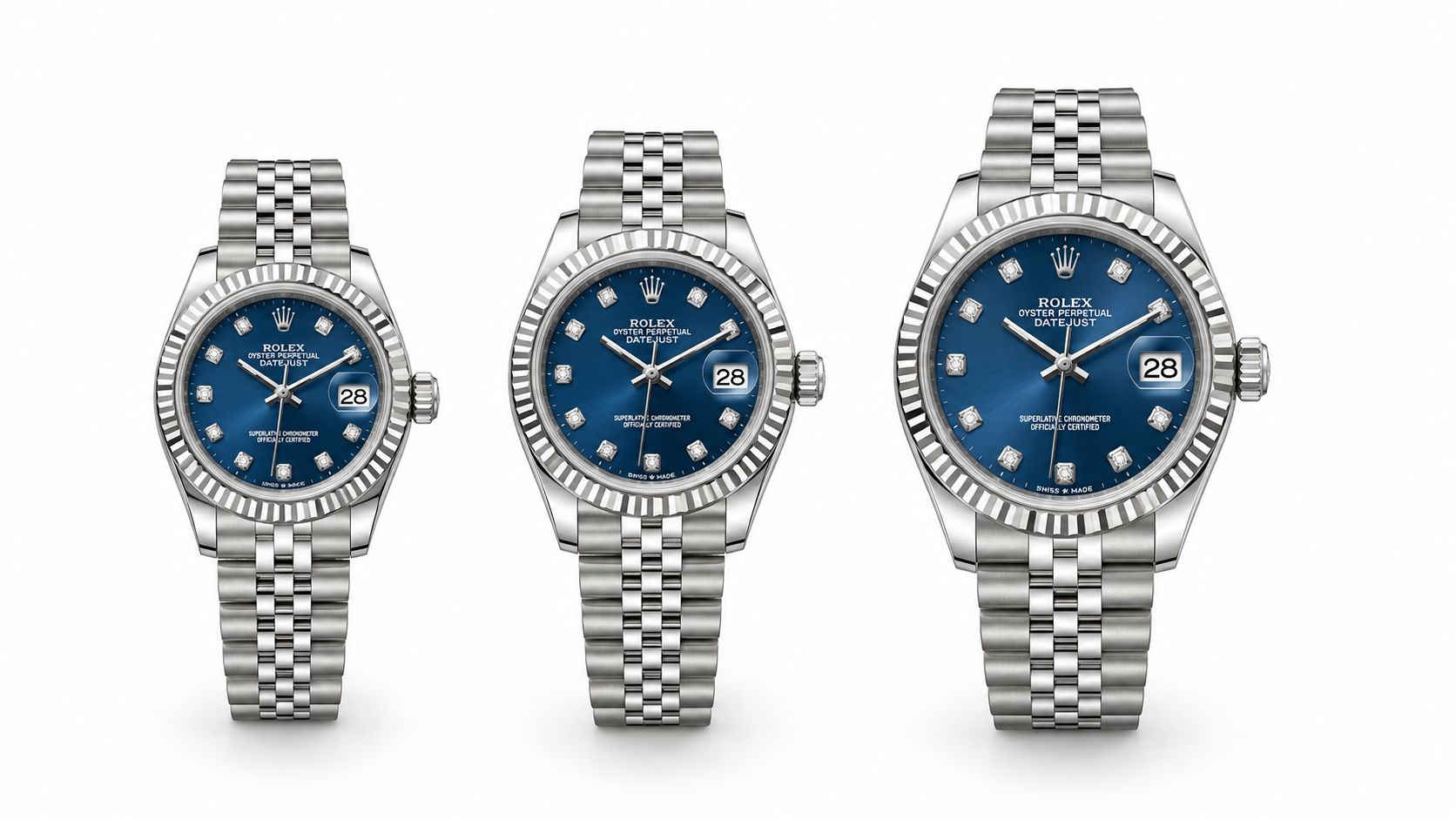
The 26 mm is the classic. It sits small, light, and close to the wrist. If you like a traditional women's dress watch, or your wrist is petite, it's still the right call. It doesn't try to make a statement. Under a cuff, it's neat and easy. Browse our Rolex Lady-Datejust 26 collection to compare references and dials.
The 28 mm is today's standard Lady-Datejust size. Rolex's current 28 mm case uses calibre 2236, with water resistance to 100 metres, or 330 feet, according to the Rolex Newsroom Lady-Datejust overview. That case is about 7.7% larger in diameter than the 26 mm generation, which sounds minor on paper and feels noticeable on the wrist. The dial opens up, the date reads easier, and the watch looks current without becoming oversized. Current examples are in our Lady-Datejust 28 collection.
The 31 mm steps into Datejust 31 territory. Many of our customers who find 28 mm a touch small choose 31 mm for better legibility. It wears more contemporary and pairs well if you stack bracelets or prefer a watch people notice from across a table. See the Rolex Datejust 31 collection, or read our Datejust 31 buyer guide.
| Size | Best fit | Wrist feel |
|---|---|---|
| 26 mm | Petite wrists, classic taste | Small, vintage-leaning |
| 28 mm | Most buyers, daily wear | Balanced, modern Lady-Datejust |
| 31 mm | Larger wrists, stronger presence | Noticeable, easier to read |
How we size it at the counter
Measure your wrist, then try the bracelet type you want. A Jubilee bracelet drapes and can make a case feel softer. An Oyster bracelet feels flatter and more structured, so the same case can look sportier.
If you're between sizes, choose 28 mm. It's the current Lady-Datejust format, it suits the widest range of wrists, and resale demand stays broad because buyers recognize it. Choose 26 mm only if you want that smaller classic look. Choose 31 mm if legibility matters more than tradition.
Which Metal and Bezel Suit a Blue Dial?
Two blue dials in the same size can look like different watches once metal and bezel change. Pick those before you debate small price differences.

Oystersteel is our pick for daily wear. It's Rolex's steel alloy for the Oyster case and bracelet. With a blue dial, it looks crisp, works with silver and white-metal jewelry, and doesn't draw attention in a professional setting. It also hides everyday wear better than polished gold.
Rolesor mixes Oystersteel with gold. Yellow Rolesor warms up a blue dial and gives you that familiar two-tone Datejust look; the 69173 and 79173 are the classic 26 mm references. White Rolesor keeps the watch mostly white-metal in appearance, with a white gold bezel, as on the 179174. Everose Rolesor adds a pink tone that softens blue and leans more jewelry-forward, as on the 28 mm 279171. If you wear both yellow and white jewelry, yellow Rolesor is the most flexible bridge. Our two-tone Rolex guide compares the options by price.
Full 18 ct gold changes the category. The watch feels heavier, looks formal, and costs materially more. Buy it because you want a gold watch, not because you think it will be a better blue dial. The dial doesn't perform differently in gold. The 69178 Lady-Datejust 26 on a President bracelet is the classic solid gold reference.
Bezel choice sets the tone
- Smooth bezel: Clean and quiet. Best with Oystersteel if you want a sport-dress profile.
- Fluted bezel: Grooved, light-catching, and traditional. It makes the watch read as a Datejust at a glance.
- Gem-set bezel: Jewelry-led and the least understated. Confirm factory setting on any pre-owned example.
We explain those profiles in detail in our guide to Rolex bezel types and what they do, and compare the two most common in fluted vs smooth bezel on a Datejust. At the counter, we usually steer first-time buyers to fluted Rolesor or smooth Oystersteel. Both stay versatile. Gem-set is right when the watch is meant to replace other jewelry, not sit beside it.
Counter advice: If you wear the watch to work daily, steel or white Rolesor with a smooth or fluted bezel will get more use than a full gold, gem-set piece.
How Much Does a Lady-Datejust Cost in 2026?
Blue dials are only a small share of Lady-Datejust production, so price the size and metal first, then expect a blue or rare dial to sit at or above the middle of the range. These are ECI asking prices for watches in stock in October 2026, across all dial colors.
| Size | Metal (references) | ECI price range |
|---|---|---|
| 26 mm | Steel with white gold bezel (69174, 79174, 179174) | $6,500 to $9,500 |
| 26 mm | Yellow Rolesor (69173, 79173, 179173) | $6,900 to $9,900 |
| 26 mm | Everose Rolesor (179171) | $10,500 to $11,500 |
| 26 mm | 18k gold President (69178, 179178, 179179) | $12,400 to $22,500 |
| 28 mm | Oystersteel, smooth bezel (279160) | $8,300 to $9,300 |
| 28 mm | White Rolesor (279174) | $10,900 to $11,500 |
| 28 mm | Yellow Rolesor (279173) | $13,500 to $16,500 |
| 28 mm | Everose Rolesor (279171) | $13,900 to $17,400 |
| 31 mm | Steel with white gold bezel (178240, 178274, 278274) | $7,900 to $13,900 |
| 31 mm | Yellow Rolesor (68273, 278273) | $8,500 to $17,500 |
| 31 mm | 18k gold (68278, 178279, 278278) | $19,500 to $43,500 |
Prices are ECI asking prices as of October 2026 and change as watches sell. The 26 mm two-tone references are the lowest-cost way into a blue dial Lady-Datejust; the 28 mm in steel is the lowest-cost current-generation option. For more on gold pieces, see our Rolex ladies' gold watch price guide.
What Movement Is Inside, and What Does It Mean for Daily Wear?
Don't buy a modern 28 mm expecting the specifications of a larger Datejust. The movement is different, and the correct expectation matters when you test a pre-owned watch.
Current 28 mm Lady-Datejust references use Rolex calibre 2236, a self-winding mechanical movement with a Perpetual rotor and approximately 55 hours of power reserve, and Rolex states post-casing accuracy of -2/+2 seconds per day, as listed in the Rolex Lady-Datejust information sheet. In plain terms, your wrist motion winds it. Wear it daily and it keeps going. Leave it off for roughly two days and you'll likely need to reset it.
Rolex also fits calibre 2236 with a Syloxi silicon hairspring and Paraflex shock absorbers in current configurations. We won't oversell what that means. For you, it's modern movement architecture built for stable daily timekeeping and shock resistance, not a reason to ignore service history.
Water resistance and legibility
The current case is specified to 100 metres, or 330 feet, on Rolex's Lady-Datejust features page for the US. That's fine for rain, hand-washing, and surface water when seals are sound. On a pre-owned watch, water resistance isn't permanent. Ask when it was last pressure-tested if you plan to swim with it.
Where fitted, Chromalight gives the display long-lasting blue luminescence in low light. It improves reading the time at night. It doesn't change accuracy.
Larger Datejust models with calibre 3235 are a different benchmark, with about 70 hours of reserve, as Rolex shows on a Datejust reference page using calibre 3235. Don't judge a 2236 against that number. If a 28 mm stops well before its expected reserve, or runs consistently outside the stated rate under stable wear, budget for regulation or service. Our overview of different Rolex movements and their generations helps if you're comparing older 26 mm references.
Which Blue Dial Lady-Datejust Should You Look At?
Use examples to narrow your taste, not to chase a catalog. Pre-owned stock turns over, and each watch is one of a kind.
Start with the classic two-tone end of the range. The Rolex 69173 Lady-Datejust 26 mm Blue Ombre Diamond Dial Jubilee Bracelet with box and papers from 1995 shows why the 26 mm Rolesor reference endures. The blue ombre dial darkens toward the edge, diamond markers add jewelry presence, and the Jubilee bracelet keeps it dressy. Our 69173 buying guide covers what to check on this reference. Check the live listing for current price and availability, since a single pre-owned example can sell and not be replaced with an identical watch.

26 mm · Yellow Rolesor · 1995
Rolex 69173 Lady-Datejust 26, Blue Ombre Diamond Dial
Fluted yellow gold bezel, Jubilee bracelet, original box and papers.
$7,900
View the watch →
If you want a little more presence, a 31 mm blue dial gives you a larger, easier-to-read face while keeping the fluted Datejust look.

31 mm · Yellow Rolesor · 2008
Rolex 77513 Datejust 31, Blue Index Dial
18k yellow gold fluted bezel, Oyster bracelet, original box and papers.
$9,500
View the watch →
Three configurations to compare in person
- Oystersteel 28 mm on Jubilee, smooth bezel: The everyday recommendation. Blue stays the focal point, steel keeps it practical, and Jubilee makes it comfortable for long days.
- Rolesor 28 mm or 26 mm, fluted bezel: The traditional choice. Gold in the bezel and center links warms the blue and works for both casual and formal wear.
- 18 ct gold, President or Jubilee bracelet: The formal choice. Buy this for weight, color, and presence, and expect a narrower buyer pool later than steel or Rolesor.
We present current pieces in that spirit at ECI Jewelers, as individual pre-owned watches with their reference, configuration, and available box and papers listed, rather than as interchangeable stock. That's the right way to shop this model. If the blue dial you want isn't in stock, our women's luxury watch collection shows everything we have now, and we can look for a specific reference for you.
Don't rank these by dial shade alone. A factory blue dial with correct markers for the reference is worth more to the next buyer than a brighter replacement dial. If an example you like has diamond markers or an ombre finish, ask for documentation that matches that exact configuration. If the seller can't explain the dial, pass, even if the photo looks perfect.
What Should You Check Before Buying a Pre-Owned Blue Dial?
We run the same checks before a blue dial goes in our case. You should ask for the same answers wherever you buy.
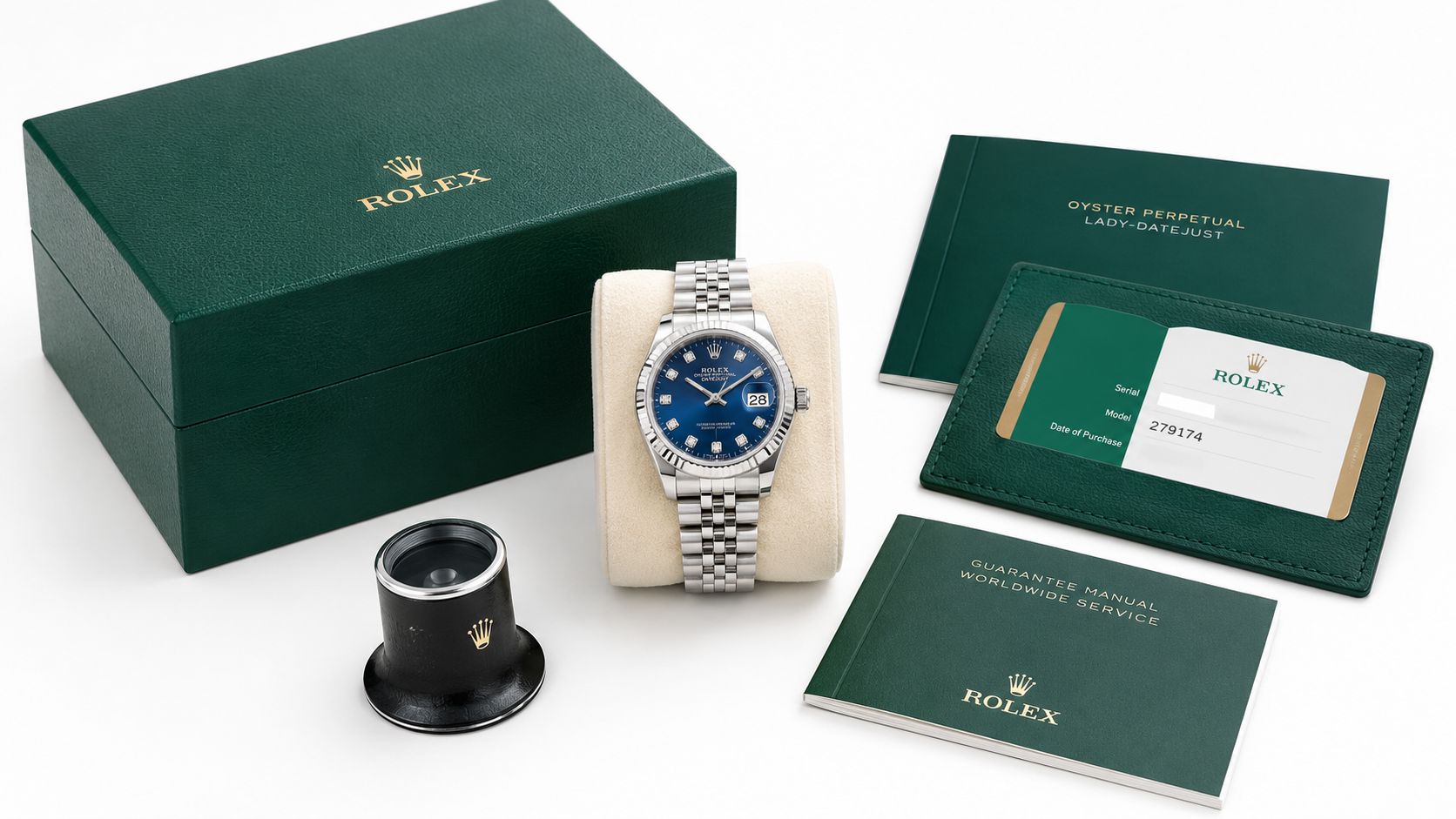
Our pre-owned checklist
- Exact reference and production year: Match them to the case, bracelet, and papers where available. Reference tells you size, metal, and bezel family. Our Rolex serial number lookup helps date a watch.
- Factory-original blue dial: Confirm the dial, markers, and hands fit the reference and era. Aftermarket blue dials are common enough that you must ask directly.
- Movement identification: Confirm which calibre should be inside that reference. Don't accept a generic statement that it is automatic.
- Service history and timegrapher reading: Ask for rate results and compare them with the movement benchmark noted above. A pretty dial won't fix a watch due for service.
- Box and papers: Original papers help confirm configuration and support resale. Their absence isn't automatic rejection, but price should reflect it.
- Bracelet condition: Check stretch, clasp function, and whether links are present to fit your wrist.
We also advise reading how sellers describe condition and documentation, which we discuss in our post on buying a pre-owned Rolex with confidence, and our 12 checks to tell if a Rolex is real. We aren't an authorized Rolex dealer and we sell pre-owned watches, so paperwork, reference checks, and inspection do the work that a factory sales channel would otherwise do. Our pre-owned ladies' Rolex buying guide covers the wider range beyond the Lady-Datejust.
If a seller won't give you the reference, movement, and dial originality in writing, don't buy the watch.
On payment, we offer financing through Affirm, Synchrony, Acima and Snap Finance, with approval and terms set by each provider, detailed on our flexible financing and leasing options page. You can also trade in or sell a luxury watch toward the purchase. That option suits customers moving from a 26 mm to a 28 mm or 31 mm.
Well-kept Lady-Datejust models tend to hold value because demand is broad, parts and service knowledge are established, and blue is a core Rolex dial color. That isn't a promise of appreciation. Condition, originality, and reference will decide what the next buyer pays.
Frequently Asked Questions
What size is a Rolex Lady-Datejust?
The current Lady-Datejust is 28 mm, introduced in 2015. The earlier generation, still the most common pre-owned size, is 26 mm. The 31 mm is the Datejust 31, the next size up, often worn by women who want a more legible dial.
How much is a blue dial Lady-Datejust?
At ECI in October 2026, a blue ombre diamond dial Lady-Datejust 26 (ref. 69173) is $7,900 and a blue dial Datejust 31 (ref. 77513) is $9,500. Across all dial colors, Lady-Datejust 26 prices run $6,500 to $22,500 and Lady-Datejust 28 prices run $8,300 to $24,900, depending on metal.
Is the 26 mm or 28 mm Lady-Datejust better?
The 28 mm is better for most buyers: it has the current calibre 2236 movement, a slightly larger dial, and the broadest resale demand. The 26 mm is better if you want a smaller, classic dress watch at a lower price.
How can I tell if a blue Lady-Datejust dial is original?
Check that the dial, markers and hands match the reference and production year, that the printing is sharp and centered, and that papers or service records describe the same dial. Aftermarket blue and diamond dials are common on the 26 mm, so ask the seller in writing.
Can you swim with a Lady-Datejust?
The case is rated to 100 metres (330 feet) when the seals are intact. On a pre-owned watch, ask when it was last pressure-tested before swimming with it.
Find Your Blue Dial Lady-Datejust
Compare references by size and metal, then ask us to walk you through dial originality and service history before you decide.
Shop Lady-Datejust →Or see every Rolex Datejust in stock.
Browse our current pre-owned Lady-Datejust selection, compare blue dial references by size and metal, and ask us to walk you through dial originality and service history before you decide. Visit ECI Jewelers to view available examples or plan a showroom visit. Prices shown are as of October 2026. Each pre-owned watch is one of a kind.


